


Summary of this article:Are You Fully Prepared to Welcome New Employees? A Step-by-Step Guide to Onboarding Procedures When hiring new employees, it is essential to properly handle various administrative procedures. Failing to complete these procedures may lead to legal complications or labor management issues down the line. In particular, the company is legally obligated to handle social insurance and tax-related procedures promptly and accurately. In this article, hubbuyer provides a detailed, step-by-step guide to the procedures required for new hires, helping you ensure a smooth onboarding process.
Step 1: Preparing Before You Start
1. Preparing and Sending a Letter of Acceptance (Job Offer Letter)
A letter of acceptance (or letter of conditional offer) is a document used to formally notify a candidate that they have been hired.
While this is not a legal requirement, it is generally recommended to prepare and send one to clarify the terms of the job offer.
Key Information to Include
⚫︎Company Name and Representative’s Name (the company’s official name and the representative’s full name)
⚫︎ Notification of Hiring Decision (We have decided to hire [Name] for the position of [Position] at our company)
⚫︎Start Date (Please join our company on [Month] [Day], [Year])
⚫︎ Start time and work location (briefly describe working conditions)
⚫︎Employment Type (Full-time, Contract, Part-time, etc.)
⚫︎Overview of Salary Terms (Base Salary, Allowances, Pay Date, etc.)
⚫︎Probationary Period (If applicable, specify the duration and conditions)
⚫︎Other Important Matters (Include employee benefits and special notes as needed)
⚫︎Response Deadline and Method of Confirmation (Specify by when and in what form the acceptance must be communicated)
Delivery Method and Follow-up
The offer letter should be sent in writing via mail or via email.
However, since this is not a formal contract, care should be taken not to confuse it with the employment contract.
Additionally, when the applicant accepts the offer, obtaining a written acceptance (such as a letter of acceptance) can help prevent future disputes.
2. Preparing the Notice of Employment Conditions and Employment Contract
Under Article 15 of the Labor Standards Act, companies are obligated to clearly specify employment conditions to employees.
The document (or electronic document) used to provide this notification is the “Notice of Employment Conditions.”
Items that must be included in the Notice of Employment Conditions (Mandatory Items)
⚫︎Term of the employment contract (whether the term is fixed or not; for contract employees, the specific contract period must be stated)
⚫︎ Place of work and job description (work location, job duties, etc.)
⚫︎Start and end times, scheduled working hours, break times, days off, and whether overtime work is required
⚫︎ Method of wage determination and payment (salary amount, types of allowances, payroll cutoff date and payment date, etc.)
⚫︎Matters regarding resignation (grounds for dismissal and procedures for voluntary resignation, etc.)
Additionally, an “Employment Contract” is a document that demonstrates that both the company and the employee have agreed to the terms of employment.
While the Notice of Employment Conditions is a unilateral notification from the company, the Employment Contract is based on mutual agreement and therefore requires the employee’s signature and seal.
Contents to be included in the Employment Contract
⚫︎Items listed in the Notice of Employment Conditions
⚫︎Details of the probationary period (treatment during the period, evaluation criteria, etc.)
⚫︎Possibility of work orders and job reassignments
⚫︎Non-compete clause (prohibition on joining a competing company after resignation, etc.)
⚫︎Confidentiality Obligations (Protecting the Company’s Confidential Information)
⚫︎Procedures upon resignation
While signing an employment contract is not a legal requirement, we recommend drafting one to prevent future disputes.
3. Information on Documents Required Upon Hiring
To ensure new employees can complete the onboarding process smoothly, please provide them with a list of required documents in advance.
Since there are documents the company must prepare and documents that employees must submit, we recommend compiling a list before the start date and sharing it with the employees.
Notify new employees of the list of documents required upon joining as early as possible so they can prepare them by the deadline.
Additionally, clearly communicating the method of submission (mail, in-person delivery, electronic submission, etc.) will help the process proceed smoothly.
The company should prepare necessary documents—such as employment contracts, payroll-related documents, and internal regulations—before the employee’s start date to ensure they can be properly provided.
This ensures that onboarding procedures proceed smoothly and allows for proper employment management of employees.
Step 2: Onboarding Procedures
1. Documents to be Submitted by New Employees
There are certain documents that new employees are required to submit upon joining the company.
Since many of these documents are necessary for social insurance, tax procedures, and payroll, they must be collected and securely stored.
⚫︎Copy of Employment Insurance Card (Submit only if you have been enrolled in Employment Insurance in the past. New graduates and those not enrolled in Employment Insurance do not need to submit this.)
⚫︎Copy of Pension Handbook (Basic Pension Number Notification)
⚫︎ Withholding Tax Statement (if the employee had a previous job)
⚫︎Declaration of Dependents (Change) for Salaried Employees (for tax calculation purposes)
⚫︎My Number documentation (required for social insurance and tax procedures)
⚫︎Certificate of Registered Matters on the Resident Record (if required by the company)
⚫︎Copy of qualifications or licenses (if performing specific duties)
⚫︎Medical Examination Report (if a medical examination is required under the Industrial Safety and Health Act)
2. Documents to be prepared by the company
⚫︎Notice of Employment Conditions (Employment Contract)
⚫︎Letter of Acceptance and Pledge (Agreement to understand and comply with company policies and rules)
⚫︎Payroll Account Registration Form (for payroll deposits)
⚫︎Application Forms for Various Allowances (if applicable, such as commuting allowance or housing allowance)
⚫︎Explanatory Materials on Company Policies and Work Rules
⚫︎Issued Items (Employee ID Card, Business Cards, Uniform, etc.) (If any items are to be issued, prepare them to be handed out on the first day of employment.
If necessary, create a list of issued items and have the employee sign it; this will facilitate the return confirmation process upon resignation.)
Step 3: Social Insurance and Labor Insurance Procedures
1. Enrollment Procedures for Health Insurance and Employees' Pension Insurance
Enrollment in Health Insurance and Employees' Pension Insurance is mandatory for all full-time employees and part-time or temporary workers who exceed a certain number of working hours at workplaces that meet specific requirements.
In particular, due to the expansion of social insurance coverage, there has been an increase in cases where even part-time workers are required to enroll at companies with a certain number of employees or more.
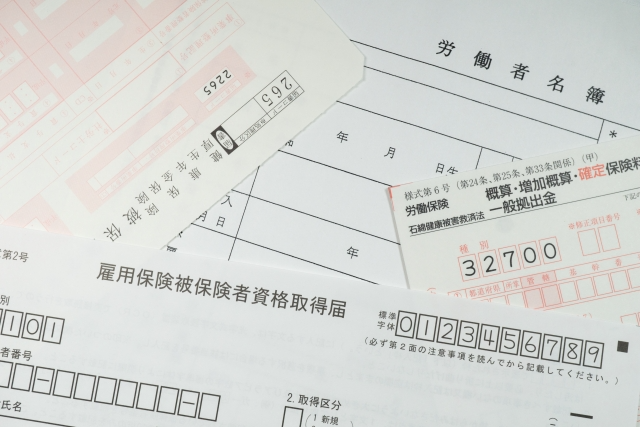
To enroll, you must first complete the “Notification of Acquisition of Insured Status for Health Insurance and Employees’ Pension Insurance” and submit it to the relevant Pension Office or Health Insurance Association.
This notification must include the employee’s name, date of birth, basic pension number, and wage information, and must be submitted within five days of the employee’s start date.
Additionally, if the employee has dependents, a “Notification of Dependents (Change)” must be submitted.
Since this notification requires documents such as a family register extract or certificate of residence to prove the relationship with the dependent, as well as an income certificate for the dependent, it is important to ask the employee to prepare these in advance.
Once the procedures are complete, a health insurance card will be issued.
Since this may take about one to two weeks, if an employee needs to visit a medical facility sooner, check the progress of the procedure and ensure the insurance card can be provided promptly.
2. Procedures for Enrollment in Employment Insurance
Employment insurance is a system that provides benefits to employees in the event of unemployment, and enrollment is mandatory for employees who meet certain working conditions.
Specifically, it applies to employees who work 20 or more hours per week and are expected to be employed for 31 days or more.
To complete the enrollment process, prepare the “Notification of Acquisition of Employment Insurance Eligibility” and submit it to the relevant Hello Work office within 10 days of the employee’s start date.
This notification must include the business name, address, employer’s name, the employee’s name and date of birth, employment status, working hours, and wage information.
Additionally, if the employee has been enrolled in Employment Insurance in the past, you must request submission of their “Employment Insurance Insured Person Certificate.”
For new enrollees, the insurance card is issued after completing the procedures at the Hello Work office; therefore, you should provide it to the employee and instruct them to keep it in a safe place.
3. Confirmation of Workers’ Compensation Insurance Coverage
Workers’ Compensation Insurance is a system that provides compensation for injuries or illnesses resulting from accidents occurring during work or commuting, and it applies to all workers.
Even part-time or temporary workers are covered by workers’ compensation insurance as long as they have an employment contract.
The first thing a company should confirm is whether it is a workplace covered by Workers’ Compensation Insurance.
If the company is not a covered workplace, it must submit a “Notification of Establishment of Labor Insurance” to the Labor Standards Inspection Office and complete the necessary procedures.
Unlike unemployment insurance, workers' compensation insurance premiums are fully borne by the company.
Premiums are determined based on the total wages of the workers, and estimated premiums must be reported and paid annually.
To ensure accurate premium calculations, the company must prepare and submit the “Labor Insurance Estimated and Final Premium Declaration Form” by the specified deadline.
Additionally, in the event of a work-related accident during employment, you must submit a “Worker Injury, Illness, or Death Report” to the Labor Standards Inspection Office.
Furthermore, when an employee requires medical treatment, the employer must prepare documents such as the “Claim Form for Medical Treatment Benefits” and complete the necessary procedures to ensure the employee receives appropriate compensation.
1. Submission of the Declaration of Dependent Deductions, etc. (Change) for Withholding Tax
This form is used to verify an employee’s family composition and dependent status. It is not submitted to the tax office; instead, the company is required to keep it on file.
If an employee fails to submit this form, tax-related deductions for dependents will not be applied, resulting in more income tax being withheld from their salary than necessary.
Submission Process and Key Points
① Provide the form to the employee and have them fill it out
During the onboarding process, distribute the “Declaration of Dependent Deductions, etc. (Change) for Salaried Employees” to the employee and ask them to fill it out.
If the employee has dependents, instruct them to accurately fill in details such as the dependents’ names, dates of birth, relationship to the employee, and whether they have any income.
Since late submission will result in higher withholding tax, be sure to collect the forms at the time of hire.
② The company verifies the contents and files the forms
Review the form completed by the employee and check for any errors or omissions.
This document is not submitted to the tax office; instead, the company must store it properly and use it for year-end tax adjustments and final tax returns.
③ Reflect in payroll calculations
During payroll processing, we apply the dependent deduction amounts based on the information in the declaration form to determine the amount of income tax to be withheld at source.
Points to Note When Filling Out the Form
★ Verify that the income of family members eligible for the dependent deduction is below a certain threshold
For example, if a dependent’s annual income exceeds 480,000 yen, they are not eligible for the dependent deduction.
★Have them resubmit the form promptly if there are any changes
If there is an increase or decrease in the number of dependents eligible for the deduction (e.g., marriage, childbirth, or a dependent finding employment), you must have them submit a change of status form.
2. Procedures for Special Withholding of Resident Tax
Resident tax is a tax levied by local governments based on the previous year’s income and paid by residents.
There are two methods: “Ordinary Collection,” where employees pay individually, and “Special Collection,” where the company withholds the tax from monthly salaries and pays it on their behalf.
In principle, companies are obligated to withhold residents’ tax from employees’ wages, so it is necessary to properly complete the special withholding procedures upon hiring new employees.
Special collection is a system whereby the company deducts resident tax from the employee’s salary each month and pays that amount to the local government where the employee resides.
By paying through the company, the employee’s tax burden is spread out, making payments easier to manage.
Special Withholding Procedure Flow
① Confirm whether the new employee was subject to special withholding at their previous job
For employees changing jobs, verify whether they have received a “Notification of Change Regarding Special Withholding” or a “Resident Tax Special Withholding Tax Amount Notification” from their previous employer.
If the special withholding is to be continued, the company must handle the tax procedures as the new employer.
② Submit the “Report on Salary Payments and Notification of Change Regarding Special Withholding” to the local government
If a newly hired employee is subject to special withholding for resident tax, the company must submit the “Report on Salary Payments and Notification of Change Regarding Special Withholding” to the municipality where the employee is registered.
This procedure notifies the local government that the company will collect and remit the resident tax going forward.
③ Receive the Resident Tax Assessment Notice from the local government and deduct the tax from monthly wages
Once the special withholding procedure for resident tax is complete, the local government will send a "Resident Tax Special Withholding Tax Amount Determination Notice" to the company.
Based on this notice, the company deducts the resident tax during monthly payroll processing and pays it to the local government by the specified deadline.
Cases Where Special Collection Does Not Apply
There are cases where special collection does not apply.
For example, if the salary is too low to allow for a resident tax deduction, or in cases of short-term employment (where the pay period is less than one year), the standard collection method for resident tax may be applied.
However, since the conditions for exemption from the special withholding obligation vary by municipality, it is necessary to confirm this in advance.
Step 5: Internal Procedures and Preparation of Supplies
1. Preparation of Employee Lists, Payroll Records, and Attendance Records
When hiring employees, you are required to create and maintain three types of records—employee rosters, payroll records, and attendance records—to ensure proper labor management.
These documents must be maintained in accordance with the Labor Standards Act and are required during inspections by the Labor Standards Inspection Office and for social insurance procedures.
Preparation of the Employee Roster
An employee roster is a record of employees’ basic information, and companies are required to create and maintain one for all employees they hire.
When creating the register, include the following information:
⚫︎Name, date of birth, gender
⚫︎ Address, contact information
⚫︎Start date of employment, employment status (full-time, contract, part-time, etc.)
⚫︎Job duties
⚫︎Date of Resignation (to be filled in upon resignation)
⚫︎Other required information (qualifications, licenses, etc.)
You are required to retain the employee roster for three years after an employee leaves the company. Manage it properly and update it whenever there are personnel changes or other updates.
Preparation of Payroll Records
Payroll records document salary payments and must be created and retained for all employees.
Since they are used for payroll calculations, tax procedures, and social insurance procedures, accurate management is required.
The following information must be included in the payroll ledger:
⚫︎ Employee’s name
⚫︎ Amount of wages paid (base pay, various allowances, deductions, net pay)
⚫︎Hours worked (scheduled working hours, overtime, late-night work, holiday work, etc.)
⚫︎Payment date and method
⚫︎Deductions for social insurance premiums, income tax, and resident tax
Payroll records must be retained for three years.
While it is possible to manage these records electronically using payroll software, be sure to verify that they meet all legal requirements.
Creating an Attendance Record
An attendance log is a record used to accurately track employees’ working hours.
Tracking working hours is essential for compliance with the Labor Standards Act, payroll processing, and monitoring overtime work.
The following information must be included in the attendance log:
⚫︎ Date of attendance, time of departure, and break times
⚫︎Overtime hours and whether work was performed on a holiday
⚫︎Paid leave usage
Employee attendance is typically managed using paper attendance logs, time cards, or attendance management systems.
Accurate tracking of working hours is essential to prevent labor disputes, such as unpaid overtime.
2. Preparing Necessary Supplies and Equipment
To ensure new employees can start work smoothly, prepare the necessary supplies and equipment in advance.
The main items that need to be prepared include a desk, chair, PC, company cell phone (if necessary), employee ID card, business cards, work clothes or uniforms (if required), and the issuance of accounts for operational manuals and internal systems.
In addition, set up the work tools that new employees will use (such as email accounts, internal chat tools, and time and attendance management systems) in advance so that they can proceed with their work smoothly from their first day on the job.
Step 6: Follow-up After Hiring
1. Conducting Orientation
It is recommended to conduct an orientation after new employees join the company to help them understand the company’s philosophy and job responsibilities, and to ensure they can smoothly grasp workplace rules and work practices.
During orientation, explain basic company information, employment regulations, and internal rules, and provide an opportunity for new employees to understand the workplace environment.
While new employees will apply their prior experience and knowledge to their work, appropriate guidance is necessary because each company has different policies and cultures.
During orientation, we first explain the company overview and management philosophy to help them understand the purpose behind our business operations.
Learning about the company’s history and business direction helps new employees develop trust in and a sense of attachment to the company.
We also explain the employment regulations and working conditions, sharing basic information such as working hours, break times, the salary structure, and employee benefits.
Providing this information in advance helps prevent issues after joining the company and creates an environment where employees can work with peace of mind.
Furthermore, we explain how to use the tools and internal systems required for daily work.
Understanding how to use the tools necessary for daily operations—such as email, internal chat, time and attendance systems, and file-sharing tools—enables employees to perform their work smoothly.
Additionally, depending on the company, training on harassment prevention and information security may be incorporated to raise awareness and maintain an appropriate workplace environment.
Since orientation serves as an opportunity to help new employees start their work without confusion, it is advisable to create a program in advance and conduct it in a planned manner.
2. Explanation of Job Duties and the Work Environment
To help new employees get up to speed quickly, it is essential to provide a detailed explanation of their job responsibilities and workflows.
Rather than simply providing an overview of the work, explaining the purpose, background, and expected outcomes of the tasks will deepen their understanding of the job.
Ensure new employees clearly grasp their roles and understand how they should proceed with their work.
When explaining job duties, first present an overview of the work the new employee will be responsible for so they can understand the role they will play within the company.
Then, provide specific details on the daily workflow, the tools they will use, and reporting procedures to help them apply this knowledge to their actual work.
Also, clearly communicate work priorities, deadlines, and evaluation criteria to ensure they can proceed efficiently.
Be sure to provide feedback as needed and create an environment where new employees can resolve any questions they may have, so they do not proceed with unresolved doubts.
It is also essential to explain the workplace environment.
By providing information in advance about daily work practices—such as how to use office equipment and supplies, how to use conference rooms, and how to spend lunch breaks—new employees will find it easier to settle into the workplace.
Explain the rules of internal communication and provide guidance on the importance of reporting, communicating, and consulting (Hō-Ren-Sō), as well as appropriate communication methods, to help build smooth interpersonal relationships within the workplace.
3. Introducing Mentors and Supervisors
To help new employees adapt quickly to the workplace and perform their duties smoothly, it is important to create an environment where they feel comfortable seeking advice.
Therefore, it is effective to designate a mentor or supervisor whom new employees can consult with easily when they encounter difficulties.
A mentor is a senior employee who supports new hires with work guidance and workplace adaptation, offering advice not only on how to perform their duties but also on company rules and interpersonal relationships.
Having a mentor allows new employees to resolve their questions and concerns immediately, preventing them from carrying their anxieties into their work.
Additionally, by receiving practical advice as needed—such as how to approach tasks and set priorities—they can learn their jobs efficiently.
Mentors help new employees acclimate to the workplace by regularly checking in with them and arranging opportunities for lunch or one-on-one meetings, making it easier for them to integrate into the company.
Direct supervisors and those responsible for on-the-job training also play a key role in supporting new employees.
By formally introducing the new employee to their supervisor on their first day and clearly defining how job training will be conducted, you can establish a smooth training system.
It is also important to schedule regular meetings and one-on-one sessions to provide a space for new employees to address their questions and concerns.
Summary
What did you think?
When hiring new employees, it is essential to properly handle a wide range of procedures, from pre-employment preparations and internal paperwork to follow-up after they start work.
By thoroughly carrying out these procedures, you not only fulfill the company’s legal obligations but also help alleviate new employees’ anxieties and improve retention rates.
Creating an environment where employees can work with peace of mind brings significant benefits to the company as well.
Let’s ensure that onboarding procedures are carried out thoroughly so that new hires can smoothly adapt to the workplace and fully demonstrate their abilities.