Introduction
HS codes are not "numbers" but "classification results"
An HS code is not merely an administrative number.
It is
• What this product is
• What is its intended use?
・Which classification it has been determined to belong to
It is a numerical representation of the customs authority’s determination.
In other words, by entering the HS code, the importer is indicating that “this product falls under this classification without issue.”
Without understanding this,
・"Because I used it last time"
・Because the supplier specified it
the HS code becomes nothing more than a number, and this can easily lead to problems.
An HS code is not a “number you are forced to choose,” but a judgment you make with full responsibility.
Errors in HS codes are not just a matter of tax rates
When people hear that an HS code is incorrect, the first thing that often comes to mind is whether the tariff rate is different.
Certainly, if the tax rate is different, it can result in additional taxes or amended tax returns.
However, in practice, the bigger problem is that it can lead to discrepancies in regulatory and inspection decisions.
The HS code is used to
・Tariff rates
・The presence or absence of import regulations
・Items subject to inspection or verification
.
If the classification changes, not only the tax rate but also the specific points that customs officials examine will change.
Assuming that “since the tax rate is the same, there’s no problem” indicates a lack of proper understanding of the role of the HS code.
An error in the HS code is not merely a cost issue; it undermines the entire premise of the import transaction.
The Most Common Mistake #1: Relying on Suppliers for HS Codes
The most common issue with HS codes is when companies simply use the codes specified by their suppliers.
The HS codes specified by the Chinese side are
・For the convenience of Chinese export procedures
・Simplified classification
・Systems and assumptions that differ from those in Japan
.
The reality is that even if a code poses no issues for export from China, it is not necessarily the correct classification for import into Japan.
Reasons such as “the other party decided it” or “there have been no problems so far” do not serve as grounds for judgment by Japanese customs.
When importing into Japan, the only thing that matters is whether the HS code can be explained according to Japanese standards.
The Most Common Mistake #2: Reusing "Code That Worked Last Time"
The next most common mistake is assuming, “Since this code worked last time, it should be fine this time too.”
However, customs makes its determination based on each import case, not on individual items.
For example,
・The specifications have changed slightly
・The description of the intended use is different
・The contents of the set or the included accessories have changed
Even these factors alone can affect the validity of the HS code.
The fact that it was approved in the past does not guarantee its correctness this time.
The assumption that “it was accepted last time” indicates that the HS code is being viewed merely as a number.
HS codes are not determined by "appearance"
There is one point regarding the determination of HS codes that is most often misunderstood.
It is the assumption that if items look similar, they will be classified in the same category.
In actual HS code classification, the following factors are prioritized over appearance:
・Material
・Intended use
・Structure
It is not uncommon for products that look similar to be assigned completely different codes if their materials or intended uses differ.
Conversely, even if products look different, they may be classified under the same code if their intended use or function is the same.
HS codes are determined based on the actual characteristics of the product, not its appearance.
Insufficient information about the intended use leads to misclassification
The root cause of incorrect HS codes is a lack of detail in the description of the product’s use.
In practice, we often see the following lack of clarity:
・Is it for commercial use?
・Is it intended for general consumers?
・Is it for decorative purposes or practical use?
Without clarifying these points, the classification will inevitably be inconsistent.
Customs makes its determination based on the importer’s intended use of the goods.
If the intended use remains ambiguous, you cannot select the correct HS code.
Only when you can explain “what the product is used for” can the HS code be determined.
The Nightmare of HS Codes for Bundled and Composite Products
Bundled and composite products are the areas where HS code issues are most likely to arise.
The reason is simple: the number of factors to consider increases significantly.
・What constitutes a single product?
・What is the primary function?
• How should accessories be classified?
If you file a declaration without clarifying these points, the classification can easily be incorrect.
Particular caution is needed in cases where the treatment changes depending on the contents of a set.
Even if the set as a whole is acceptable,
・Only a part of it may be subject to regulations
・The accessories alone may be classified differently
such determinations may be made.
The notion that “since they’re sold together, they’re a single item” does not apply in the world of HS codes.
Real-world problems caused by incorrect HS codes
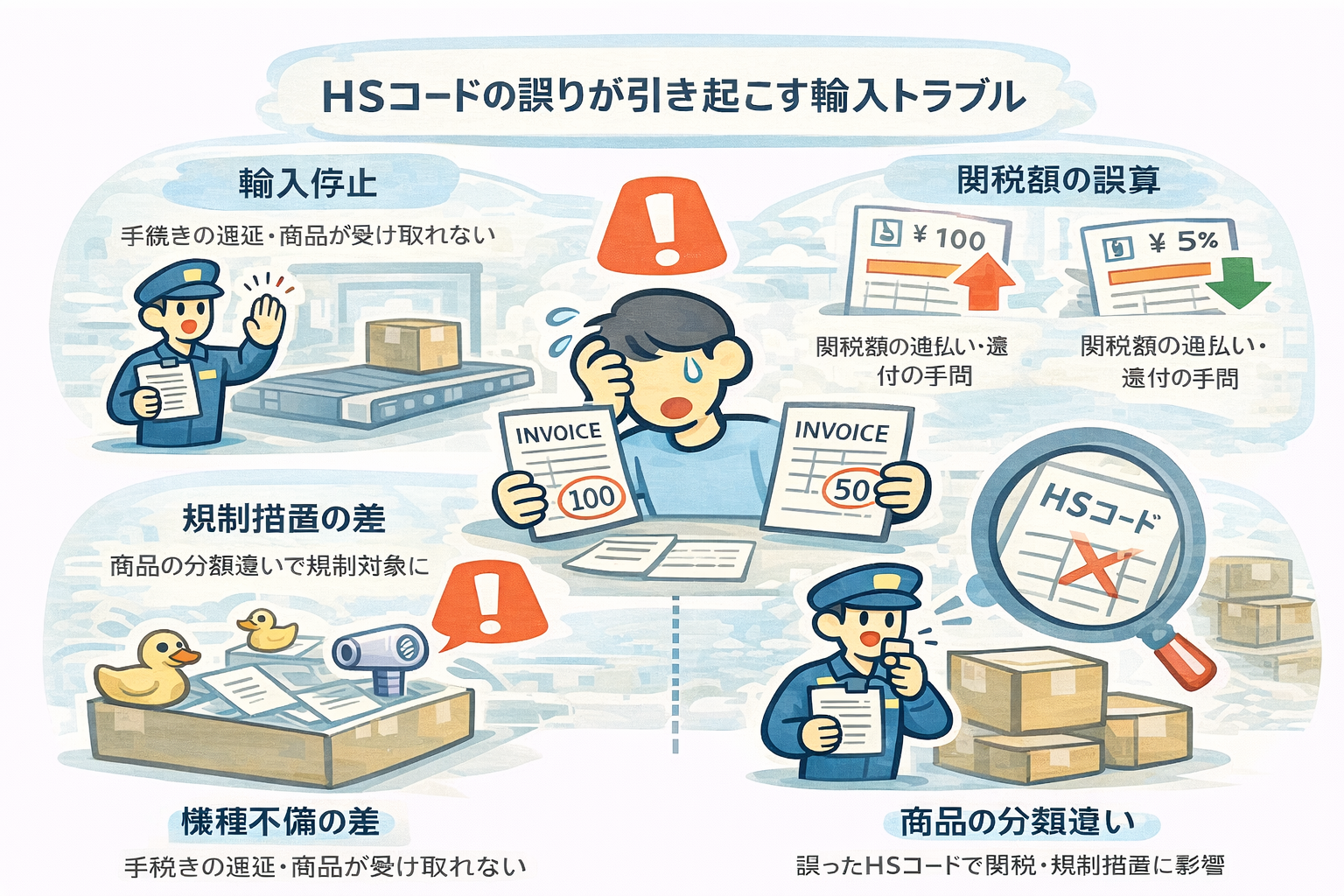
If the HS code is incorrect, it’s not just a matter of correcting the number.
In practice, this can lead to the following issues:
・Amended tax return
・Additional tax assessments
・Change in inspection status
・Significant delays in customs clearance
In some cases, the import may not be completed at all.
Particularly serious are cases where regulatory determinations change due to differences in HS codes.
In such cases, the approach of “we can just correct it later” is not feasible.
"I didn't mean any harm" won't cut it
When it comes to errors in HS codes, the following explanations are often heard:
"I didn't know," "It wasn't intentional"
However, these are not valid grounds for exemption.
HS codes are not determined by customs or suppliers; they are determined and declared by the importer.
If an incorrect HS code is declared, even if there was no malicious intent, the responsibility lies with the importer.
An HS code is not a “number you are told to use”; it is a classification that you must determine and explain yourself.
The more lightly you take this, the higher the risk of trouble becomes.
Why Do Errors in HS Codes Keep Happening?
The reason errors in HS codes keep occurring is not because classification is difficult.
The cause is that the decision-making process leading to classification is being skipped.
A common issue in practice is that
・It is not clear who is responsible for determining the classification
・The basis for selecting a particular code has not been documented
・The classification is not in a state where it can be explained to a third party
If you proceed under these conditions, even if the process passes once, the same problems will arise time and time again.
Tips for Avoiding HS Code Issues
The key to avoiding problems with HS codes isn’t about getting the correct code right the first time.
What matters is being able to explain why you chose that HS code.
At a minimum, the following points must be clearly defined:
・What is the material?
・What is its intended use?
・What is the structure and function?
If these points are clearly organized, you will be able to respond with a solid rationale even if customs requests verification.
HS codes are not something to be determined by rote memorization or guesswork; they are derived by building a logical explanation.
HS codes are not "costs" but "prerequisites"
Verifying HS codes is often perceived as a time-consuming and tedious task.
However, in practice, the HS code is a prerequisite for completing an import.
If you proceed without clarifying this,
・Corrections will be required later
・Regulatory compliance may not be met in time
・The import itself may be halted
Such complications are bound to surface at some point.
HS codes are not a task that can be put off.
Summary
An error in the HS code is not a "classification mistake" but a "failure to make a determination"
An error in the HS code is not merely a classification mistake.
・Failure to clarify the intended use
・Inability to explain the structure
・Reliance on others for judgment
These errors result from such conditions.
The HS code reflects the importer’s judgment.
If you approach them with a clear understanding of this, you can certainly reduce import issues caused by HS codes.
It is not about “selecting a number,” but about demonstrating your judgment.
Whether or not you can maintain this mindset is the biggest turning point that separates successful imports from those that get held up.