What Happened to SGH Global Japan?
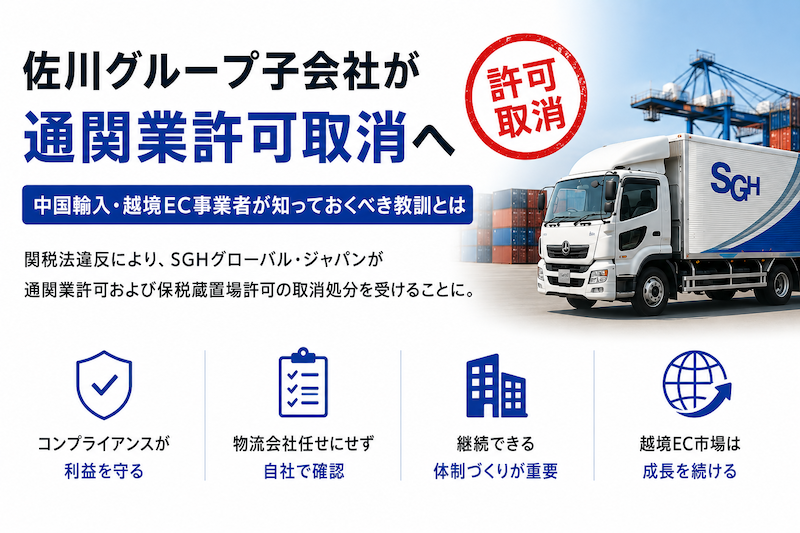
First, let’s review the details of this case.
According to an announcement by SG Holdings, an investigation by the Tokyo Customs Office revealed that foreign cargo handled at the Tokyo Logistics Center bonded warehouse in June 2025 was released before the required import permit from the Director of Customs had been obtained. *Reference: SG Holdings, “Regarding Administrative Sanctions Against Our Consolidated Subsidiary”
Imported goods must undergo customs import declaration and authorization procedures in order to be officially brought into Japan.
This is an important procedure not only for the proper collection of customs duties and import consumption tax but also to verify compliance with various laws and regulations.
However, in this case, the fact that foreign cargo was picked up before receiving the Customs Director’s permission was deemed problematic.
Tokyo Customs determined that this action constituted a violation of Article 67 of the Customs Act and has issued a formal notice of disciplinary action against SGJ and the employees involved.
As a result, the following administrative sanctions were imposed:
・Suspension
The suspension of customs clearance operations from June 1, 2026 to August 31, 2026
・Revocation
The revocation of the customs brokerage license effective September 1, 2026 and the revocation of the bonded warehouse permits for the Narita Logistics Center and the Kansai Airport Logistics Center
The revocation of a customs brokerage license is an extremely serious penalty for a company. Customs clearance operations are fundamental for import and export businesses and losing this license has a significant impact on the business' continuity. Also, the revocation of the bonded warehouse permits can impose significant constraints on the logistics operations.
Why did violations occur at a major logistics company?
Is there a reason why this problem occured at a major logistics company?
According to SG Holdings, the following were cited as main causes:
・A decline in employee awareness of compliance rules
・An increase in cargo volume due to the rapid growth of the cross-border e-commerce market
・Insufficient staffing
・Operations that prioritized delivery lead times over compliance rules
・Inadequate governance systems
Of particular note!, the company’s explanation stated this“a situation had risen where we were forced to prioritize delivery lead times over legal compliance.”
In the e-commerce market in recent years, delivery speed has become a key competitive factor. As major e-commerce platforms, including Amazon, compete on delivery speed, logistics companies are required to have a higher processing capacity than ever before.
Furthermore, with the expansion of the cross-border e-commerce market, small-lot shipments imported from China to Japan are also on the rise. Logistics operations must process large volumes of cargo in a short while, making staff shortages and increased workloads a major challenge.
SG Holdings has explained that this issue was not merely a matter of individual employee misconduct but also a reflection of problems with the organization’s overall management and governance systems.
This incident from now on serves as a case study demonstrating how crucial it is to balance legal compliance rules and operational efficiency in the logistics industry which supports the rapidly growing cross-border e-commerce market.
Will this have an impact on businesses importing from China?
What impact will this administrative action have on businesses importing or buying from China and cross-border e-commerce operators?
To put it simply, at this point, the direct impact on general importers is expected to be limited.
SGJ has announced that, to avoid any impact on customer cargo, it will outsource its future customs declarations and warehousing operations from partner companies. Therefore, it is unlikely that logistics will come to an immediate halt or that cargo transportation will be significantly disrupted.
However, as the transfer of operations proceeds, the following impacts may arise depending on the circumstances:
・Delays in customs clearance
・Temporary disruptions due to the transfer of operations
・Fluctuations in delivery lead times
・Impact on the processing capacity during peak seasons
Therefore, it is important for businesses making FBA shipments or delivering to warehouses to manage their schedules with ample lead times while monitoring updates and logistics statuses from their logistics providers.
This incident serves as a reminder not only of issues within logistics companies but also of the importance of compliance frameworks and operational management as businesses grow.
Compliance Protects Profits in Chinese Import Business
In the business of importing from China, it's easy to focus solely on profit margins but in reality, compliance is a critical factor in safeguarding profits.
Imported goods are subject to various laws and regulations.
Some of the most notable include:
・Electrical Appliance and Material Safety Act (PSE)
・Food Sanitation Act
・Pharmaceutical and Medical Devices Act
・Radio Act
・Household Goods Quality Labeling Act
・Act Against Unfair Competition and Intellectual property laws such as the Trademark Act and the Design Act amongst others.
Selling products without a full understanding of these laws can result in:
・Sales suspension
・Product recall
・Suspension of listings or account suspension
on e-commerce platforms.
Prioritizing short-term profits over compliance with rules and regulations can ultimately lead to significant losses.
It’s also important not to rely entirely on logistics companies or third-party service providers
Some beginners in importing from China assume that because logistics companies or import agents handle everything, all will go well.
However, the ultimate responsibility as an importer lies with the business owner.
Therefore,
・Verification of product regulations
・Investigation of intellectual property rights
・Confirmation of required certifications and notifications
・Review of product descriptions on sales pages must be thoroughly verified by the business owner themselves.
It is possible to reduce risks by utilizing reliable logistics or agency companies.
However, it is important to maintain the awareness that the ultimate responsibility lies with the importer.
Even while utilizing logistics companies or agents, it is crucial to understand the items that must be verified in-house and to establish an appropriate management system.
It is important to establish a system that supports compliance
In the business of importing or buying from China, it is important not only to conduct product research and develop sales strategies but also to establish systems for ensuring ongoing compliance with laws and regulations and maintaining quality control.
As a business grows, it will face a substancial growth and increase such as:
・an increase in the number of products
・an increase in the number of purchases
・an increase in OEM projects and an increase in logistics volumes
This substancial growth causes more complexity as far as management tasks are concerned. Therefore, while it is essential for business owners to acquire the necessary knowledge themselves, selecting partners and agents to support inspection, logistics and quality control is also crucial.
As this case study illustrates, business growth leads to an increase in workload, a risk of oversight and the risk of inadequate management also rises. This is why it is crucial to establish systems for continuous management rather than relying solely on individual experience and attention to detail.
At HubBuyer, we provide comprehensive support for everything from sourcing in China to OEM, inspection, logistics and shipping. Leveraging the expertise we’ve cultivated in supporting Chinese imports for the Japanese market, we help businesses improve on their operational efficiency and quality control.
What does the future hold for the cross-border e-commerce market?
The cross-border e-commerce market is expected to continue growing.
Demand for imports from China to Japan is also expected to remain high.
On the other hand,
・Compliance with import regulations
・Intellectual property protection and requirements for product safety and quality
・Expectations for logistics quality and delivery services will become even more important than ever before.
In other words, the import business of the future will require more than just “buying low and selling high”; compliance with laws and regulations, quality control and the establishment of a stable logistics system will become increasingly essential.
To achieve long-term business growth, it will be essential to focus not only on price competition but also on quality and reliability.
Summary
The recent administrative sanctions imposed on SGH Global Japan serve as a significant warning not only to the logistics industry but also to businesses involved in imports from China and cross-border e-commerce.
SG Holdings cites a lack of compliance awareness, insufficient staffing, an excessive focus on prioritizing delivery lead times and deficiencies in governance systems as the underlying cause of this issue.
These challenges are not limited to the logistics industry; they contain many points that are also relevant to businesses importing from China.
As a business grows, the volume of work increases, making it easier for oversights and management errors to occur.
Therefore, it is essential to establish systems and check mechanisms to ensure compliance with regulations.
The cross-border e-commerce market is expected to continue growing.
However, to support this growth, it is necessary to pursue not only “speed” but also “compliance” and “quality control” simultaneously.
Rather than viewing this case study as someone else’s problem, it is important to use it as an opportunity to review your own company’s operational and management systems.
To enhance competitiveness in the future of the China import and buying business, it is crucial to focus not only on profits but also on compliance and quality control while ensuring sustainable business growth.