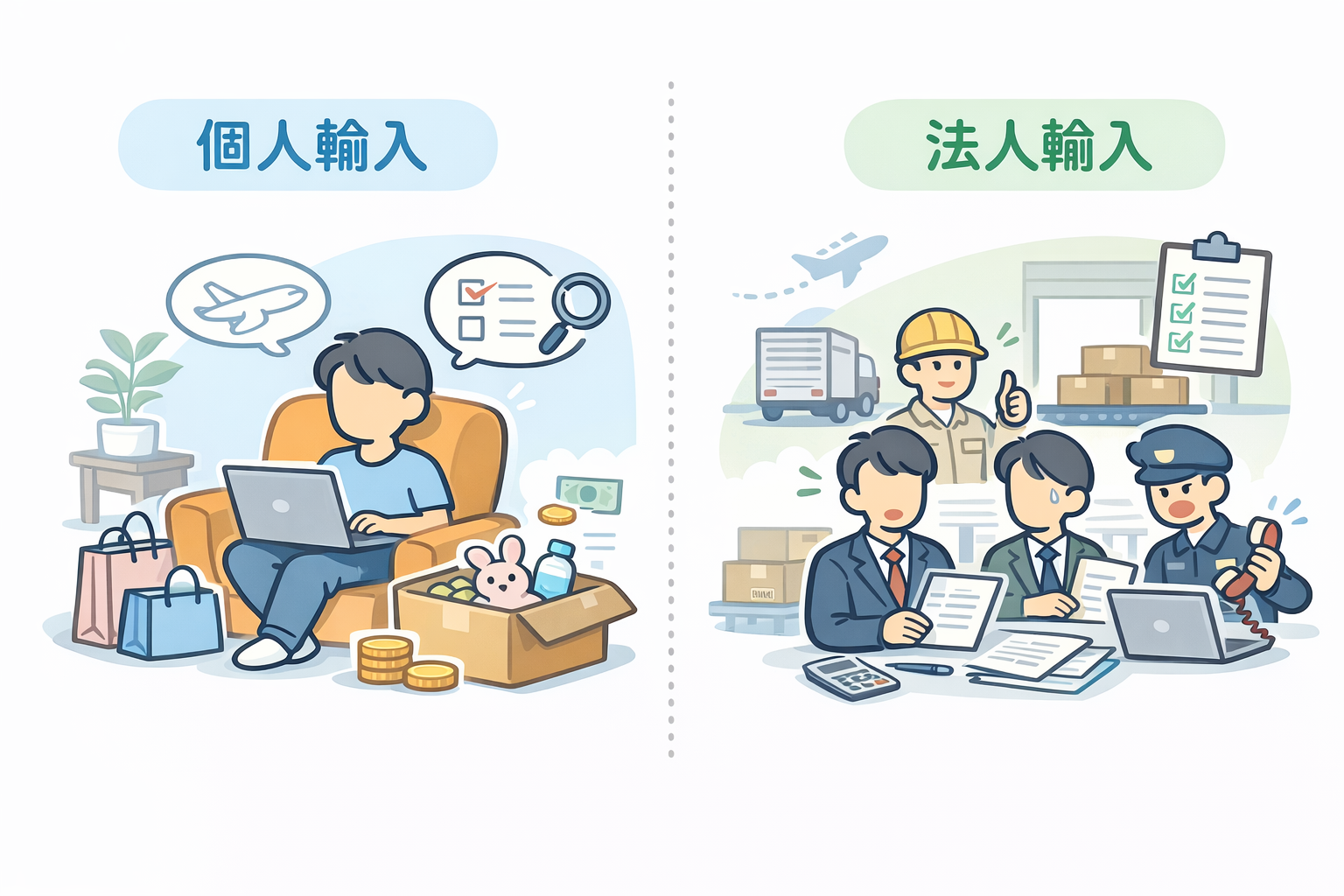
Introduction
Whether you're an individual or a corporation it never changes the manner in which you're perceived
People often assume that the only difference between personal and corporate imports is the name on the account.
However, in practice, from the custom official's perspective, the points to verify and the level of explanation required is different.
Due to this, it will be fair to say that there is no advantageous or disadvantageous rank or position, be you an individual or a corporation.
What is important is that the underlying positions and structures are different.
In this article, we will clarify the differences between personal and corporate imports not based on intuition or perception but from the perspective of the structure and rules of customs operations.
What exactly are personal imports and corporate imports?
First, let’s clarify the basic definition.
・Personal Imports: These are imports made in an individual's name, intended for personal use or private consumption.
・Corporate Imports: These are imports made in the name of a corporation intended for sales or business use
At first glance, the difference seems simple.
However, it is precisely this difference in premise that affects customs' criteria for judgment, verification scope and the extent of your accountability.
Because these premises differ, even if the product and quantity are the same, the way they are viewed changes significantly.
Differences in what customs officials look at first
The first thing customs officials check is what the purpose of the import is.
In the case of personal imports, they primarily examine whether the goods are for personal use and whether the quantity is within reasonable limits.
Here, the focus is on whether the goods are truly for personal use or intended for resale or business purposes.
On the other hand, the premise is different for corporate imports.
For corporate imports, it is assumed from the outset that the import is for business purposes, that it is ongoing and that it is intended for sale.
In other words, from the moment goods get to customs under a corporate name, customs authorities view the import as a “commercial import” by default.
This difference in initial perception determines the scope of subsequent verification and the level of detail required in explanations.
Differences in Approaches to Taxation and Filing
In the case of personal imports, if the shipment is a "small quantity" or a one-time purchase, it may be subject to simplified procedures.
While this doesn't mean the process is always simple, if the shipment is deemed a“personal import" based on its intended use and quantity, the required verification steps may be limited.
On the other hand, the approach is significantly different for corporate imports.
For corporate imports, stricter and more consistent explanations are required regarding the "reasonableness of the taxable value," "consistency of HS codes," and "explanation of the terms of trade."
The key point here is that the mindset of "it went through before” or “there were no issues last time” is largely irrelevant in corporate imports. Corporate imports are based on the premise of accountability with every shipment and past clearance records do not serve as a get-out-of-jail-free card.
If you do not understand this difference, even if you believe you are following the same procedures as before, customs scrutiny may suddenly become much stricter.
Why the approach to legal regulations is changing so significantly
One aspect that is often overlooked in personal imports is the difference in how legal regulations are applied.
In the case of personal imports, certain legal regulations may be treated as an exemption in practice if the items are for personal use and in small quantities.
However, this does not mean that“regulations do not exist.”
On the other hand, corporate imports operate under different premises.
Since corporate imports are based on the premise of “sale” or “business use,” various legal regulations—including PSE—and labeling requirements generally apply.
If you approach this with the same mindset as personal imports, you may find yourself in a situation where you“don't understand why it was stopped.”
Legal regulations are applied differently depending on the intended use and the importer's status, not the product itself.
It is not uncommon for a lack of understanding of this structure to result in shipments being held up at customs.
What Quantity and Frequency Mean
Even quantities that are unlikely to cause issues for personal imports can have different implications for corporate imports.
Customs officials are not looking at the numbers themselves.
If large quantities and high import frequency coincide, this strongly supports the conclusion that the imports are being conducted as a business.
As a result, customs will raise the level of scrutiny regarding the consistency of the declaration, the reasonableness of prices and terms of trade alongside the alignment between documentation and actual conditions.
The perception that "the quantity isn't large” or “the amount per shipment is small” is not sufficient to meet the criteria for corporate imports.
Quantity and frequency are consistently viewed as key indicators of the nature of the import.
Why it stops the moment you switch from an individual to a corporation
One of the most common questions we receive is, “There were no issues when I was an individual but my shipment was held up at customs after I incorporated.”
However, this does not mean that customs regulations have suddenly become stricter. What has changed is the premise under which customs officials view the situation.
The moment the shipment is registered under a corporate name, it is treated as an import intended for sale, intended for continued use, and part of business operation.
In other words, everything is checked from the outset on the premise that it is a“commercial import.”
If you think of it as an extension of personal imports, you might wonder,“Why am I suddenly being asked so many detailed questions?" or “I'm doing the same thing as before,” but in reality, the underlying basis for the inspection has simply changed.
Failure to understand this shift in perspective is the primary reason why imports "stop the moment you incorporate.”
Differences in the level of detail required in documents
In the case of personal imports, customs clearance may proceed even if the description is somewhat vague.
This is because the scope of verification is limited, based on the premise that the goods are for personal use and in small quantities.
However, the situation is different for corporate imports.
For corporate imports, authorities rigorously verify the consistency of documents, whether the actual nature of the transaction can be explained and whether there is a reasonable basis for the price.
The key point here is that the focus is not on whether the documents have been submitted but rather on whether they constitute a valid explanation.
Even if invoices, contracts and other documents exist individually, the verification process is not complete unless they collectively form a coherent explanation.
In corporate imports, these documents serve as the explanatory materials for customs.
Considerations for Personal and Corporate Imports
There is no inherent "good" or "bad" when it comes to personal imports versus corporate imports.
What matters is whether it suits the purpose of the import.
For testing purposes or personal use, personal imports may be the appropriate choice in some cases.
On the other hand, if the goal is to sell the goods or to purchase them on an ongoing basis, corporate importation is the standard approach.
If you proceed without clearly defining this distinction, you are likely to encounter problems such as a mismatch between the registered name and the actual business operations, inconsistent explanations and unstable customs clearance.
It is important to view the choice between personal and corporate importation not as a matter of tax savings or convenience but as a decision made to ensure structural consistency.
Common Misconceptions and Dangerous Ways of Thinking
There is a common misconception regarding personal and corporate imports.
People tend to make judgments based solely on the name—thinking that imports under an individual’s name will pass through customs easily or that using a corporate name will build trust.
However, in reality, customs officials do not focus on the name itself.
What they examine is the “substance” of the transaction: the purpose of the import, the actual nature of the transaction, whether the documents match the goods and whether the explanation is logically sound.
Even if the name is an individual's, if the actual nature of the transaction is commercial, it will be treated as a commercial import.
Conversely, even if the name is a corporation, if the explanation is vague, the scrutiny will be stricter.
The name is merely the starting point.
What is truly being assessed is the structure of the import itself.
Practical criteria for avoiding problems
The key to avoiding problems isn’t deciding first whether to operate as an individual or a corporation.
The first things to consider are: why you are importing, the scale of the operation and whether you plan to continue it.
If you leave these premises vague and simply decide,“I’ll start as an individual for now”or“I’ll set up a corporation just to be safe,” your explanations will become inconsistent later on.
Whether to operate as an individual or a corporation should be chosen as a result of clarifying your strategy and actual circumstances.
Determine the structure first, then choose the appropriate legal entity. Sticking to this order is the most practical way to avoid risks.
Summary
Understanding The "Differences In The Underlying Premises," Not Just Whether It's An Individual Or A Corporation
The difference between personal and corporate imports lies not so much in systematic differences or procedures but rather in underlying assumptions.
Customs does not focus on the label“individual” or “corporation,”but rather on the purpose of the import.
If the purpose, scale and continuity are clearly defined, the choice of who is making the import will naturally follow.
If you make your decision based on an understanding of these underlying principles, you can significantly reduce unnecessary troubles such as miscommunications, unexpected delays or anxiety caused by unclear reasons.
Whether you're an individual or a corporation is not the end goal. It is merely an option for aligning the structure.