Basic Rules for PSE Determination
Electric heating appliances are in high demand as winter items.
When considering sourcing from China or selling via OEM, the first question many people ask is,
"Does this product require a PSE mark?"
.
To put it simply,
whether a PSE mark is required for electric heating appliances depends on specific conditions—it can be either “required” or “not required.”
And the criteria for determining this often lie in a point that is surprisingly misunderstood.
Conclusion: Whether PSE is required is determined by "how the power is connected," not by the "product name"
First, let’s summarize the most important conclusion.
Whether a PSE mark is required depends on
・Whether it is an electric heating appliance
・Whether the product generates heat
.
The determining factor is the power supply structure (where the power comes from).
Basic Rules for PSE Determination
The determining factor is "whether it uses a household AC power source (100V AC)."
Under Japan’s Electrical Appliance and Material Safety Law (PSE),
electrical appliances that use household AC power (100V AC) are the primary targets of regulation.
In other words,
・Whether it connects directly to a household outlet (100V)
• Comes with a power adapter designed for 100V
These factors determine whether a product falls under PSE regulations.
Conditions for Electric Heating Appliances That Do Not Require the PSE Mark
If all of the following conditions are met,
the PSE mark is generally not required on the main unit.
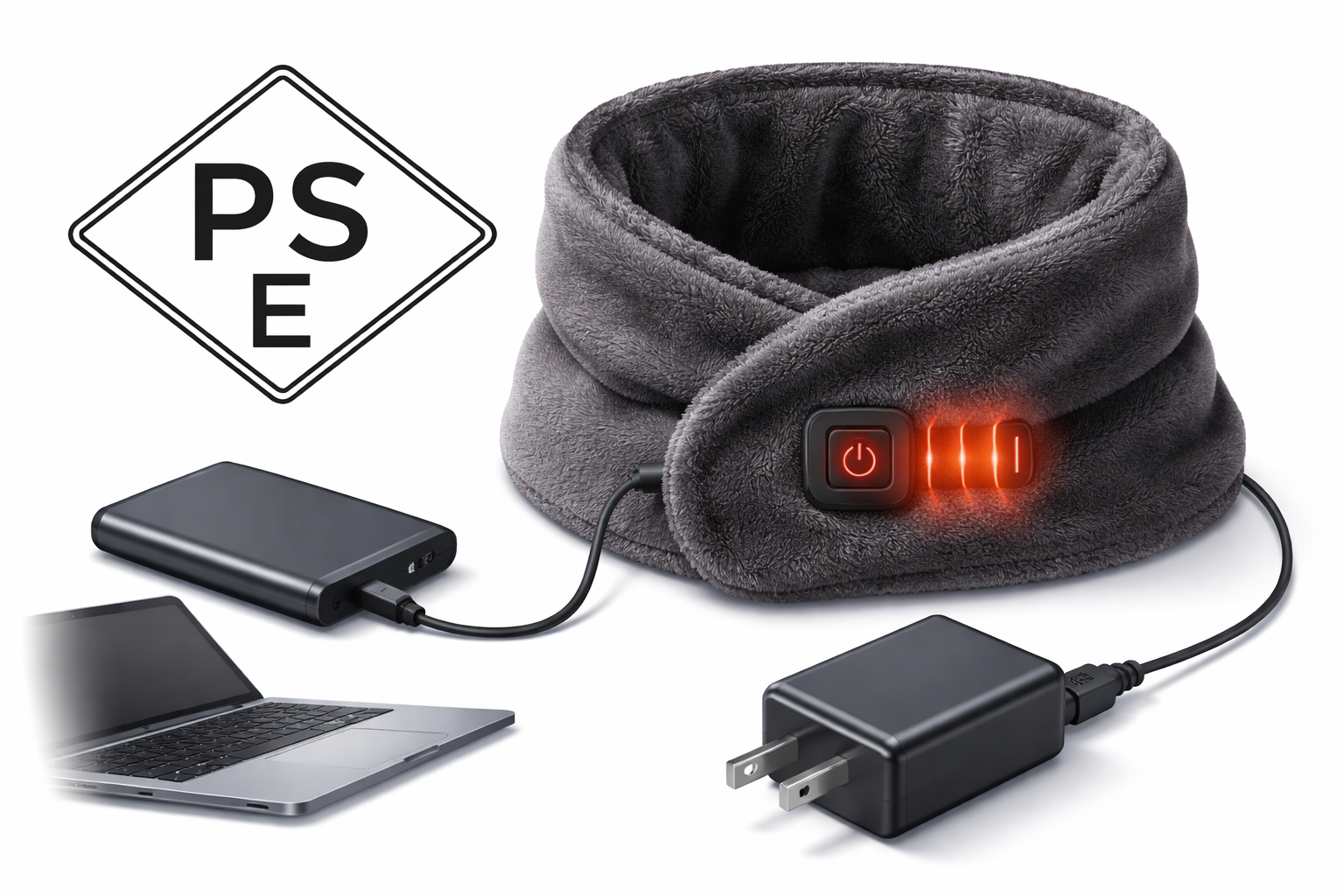
・Operates solely on USB power (5V)
・Powered by a PC or portable battery
・No AC adapter included
・Designed not to be connected directly to a standard 100V household outlet
Products of this type are
are generally treated as "products using low-voltage DC power" and
and are generally exempt from PSE regulations.
Currently, many electric neck warmers sold online
fall into this "USB-powered" category.
Cases Where the PSE Mark Is "Required"
However, caution is advised in the following design and sales scenarios:
① When an AC adapter is included
Even if the device itself is USB-powered,
if an AC adapter (100V to USB) is included in the set,
the AC adapter itself is subject to PSE certification.
In this case,
・Neck warmer unit: PSE not required
・Included AC adapter: PSE required
.
A common practical issue is when
"I thought the main unit was fine because it uses USB,
but the included adapter didn’t have PSE certification, so sales were suspended.”
.
② When the main unit is connected directly to 100V (not recommended)
The following specifications represent a particularly high-risk design:
・The power cord is directly connected to the main unit
・Connected directly to a household outlet (100V) for use
・Structure designed for 100V AC
In this case,
the electric neck warmer unit itself becomes subject to PSE certification,
・Compliance with technical standards
・Notification
・Labeling requirements
and other requirements, significantly raising the bar.
As a clothing or accessory product,
this design is practically never recommended.
Common Misconceptions and Misunderstandings
Here is a summary of the most common misconceptions regarding PSE.
Misconception 1
"Products that generate heat = PSE certification required"
→ Incorrect
It is not whether the product generates heat,
the type of power source used.
Misconception 2
"All electrical appliances = subject to PSE"
→ Incorrect
There are many electrical products that are not subject to PSE,
there are many electrical products that are exempt from PSE certification.
Practical Considerations for Importing and Selling (Very Important)
Here are some practical tips for
Here are some practical tips for selling them safely and without issues.
Design and Sourcing Stage
・Specify USB power supply (5V) only
・Avoid designs that require direct AC 100V power
・Product Contents
・Do not include an AC adapter
・If an AC adapter must be included, use only PSE-certified adapters
Product Page Description
・"USB-powered"
・"AC adapter not included"
・"Please power the device using a portable battery, PC, or similar source"
By clearly stating these points,
you can reduce the risk of consumer disputes and regulatory scrutiny.
Summary
Finally, let’s summarize the key points from this session.
USB-powered (5V) electric neck warmer
→ Generally, no PSE mark required
Includes an AC adapter
→ PSE certification required for the adapter
Designed for direct 100V connection
→ High risk; not recommended
PSE is not just a "somewhat intimidating regulation";
but a regulation that can be avoided at the design stage if you break down the structure and assess it.
Contact Information (Official)
If you are unsure,
the most reliable approach is to contact the following office directly.
Ministry of Economy, Trade and Industry
Bureau of Economy, Trade and Industry, Industrial Policy Department, Consumer Economy Division, Product Safety Office
https://www.meti.go.jp/policy/consumer/seian/denan/contact.html