Basic Customs Clearance Process
When importing or buying goods from China, customs clearance is always required. First, let me explain the basic customs clearance process.
When goods arrive at customs, a customs broker classifies them based on a number called the HS code.
An HS code is a globally standardized number used to classify products during import and export.
They were established based on the HS Convention, the "International Convention on the Harmonized Commodity Description and Coding System."
In Japanese, it is sometimes referred to as the “Import/Export Statistical Item Number,” “Tariff Number,” or “Tax Number.”
By looking at the HS code, you can determine the applicable tariff rate for the goods and the rules of origin used to determine the country of origin.
Comprising 21 sections and 97 chapters, the HS code subdivides product classifications in the order of the first two digits, four digits and six digits.
The first six digits are used as a universal code worldwide.
The digits from the seventh digit onward are called statistical subdivisions and vary by country.
Japan has established a 9-digit HS code system that includes a 3-digit statistical subdivision.
Customs brokers determine the HS code based on the materials and intended use of the products being imported or exported, prepare an import declaration and submit it to customs.
Afterward, customs officials verify the import declaration and if there are no issues, the goods are cleared.
If a problem is identified, the import declaration must be rewritten or the goods inspected.
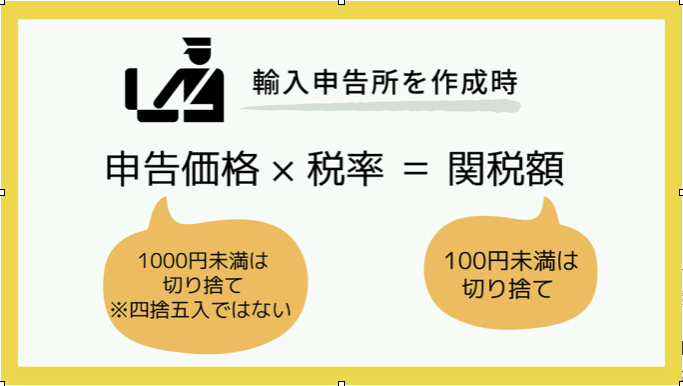
The formula used by customs brokers to calculate the duty amount when preparing an import declaration is as follows:
The Tariff System and the RCEP Agreement
When importing or buying products from China to Japan, the tariff rates established under the WTO Agreement—as determined by meetings of the World Trade Organization (an international organization for trade)—apply.
In summary, these are tariff rates under which WTO member countries and regions, including Japan, have committed (conceded) not to impose tariffs exceeding a certain rate.
In contrast, there are also tariff rates under an agreement known as the RCEP (Regional Comprehensive Economic Partnership).
RCEP is the world’s largest regional economic partnership agreement, involving a total of 15 countries, including Japan, China, South Korea, and the Association of Southeast Asian Nations (ASEAN).
It came into effect on January 1, 2022, and marks Japan’s first economic partnership agreement with China. By using the tariff rates under the RCEP agreement, you can benefit from reduced tariffs, depending on the product.
However, to qualify for the RCEP tariff rates, products must be of origin from a signatory country and a Certificate of Origin—which serves as proof of compliance with the rules of origin—must be submitted.
The RCEP Agreement adopts three systems: (1) The third-party certification system, (2) The authorized exporter self-certification system, and (3) The self-declaration system.
Under (1), a designated issuing authority (in Japan, the Japan Chamber of Commerce and Industry) issues the certificate of origin.
Under (2), an exporter who has been certified in accordance with their country’s laws (in Japan, certification by the Minister of Economy, Trade and Industry) issues the certificate themselves.
Under (3), either the exporter, producer or importer prepares a declaration of origin.
Businesses may choose any of these certification systems.
Certificates of origin must provide detailed information ranging from raw materials to finished products and there is a small fee associated with preparing the certificate.
In addition, to respond to verification requests from Japanese customs, it is necessary to prepare and retain relevant documents.
Summary
When buying and importing goods from China, you should compare the standard applicable tariff rates with those under the RCEP agreement based on the HS code to determine which to use.
There are two main types of tariff rates: those under the WTO Agreement and those under the RCEP Agreement.
WTO Agreement rates are applied automatically without any action on your part.
If you wish to apply the RCEP Agreement rates, you must prepare various documents.
When sourcing from China, checking the tariff rates in advance and deciding which type to apply can help reduce the procurement costs.