Introduction
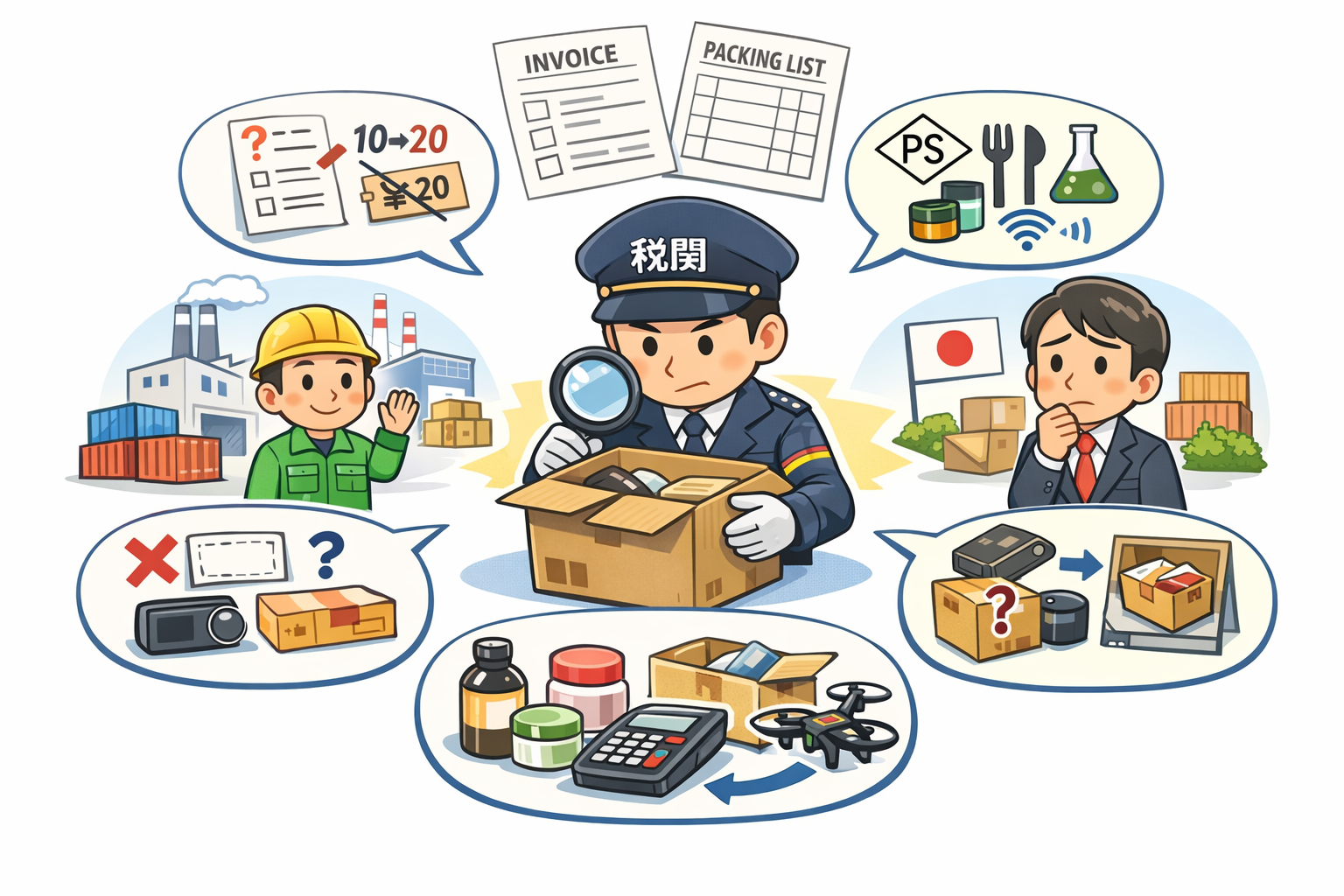
Japanese laws and regulations are "import standards," not "sales standards."
Many people view Japanese laws and regulations as “rules to be followed when selling in Japan.”
However, in practice, many regulations are designed on the premise that they must be met at the time of import, not at the point of sale.
In other words, before considering whether a product can be sold or how it will be sold, the first question is whether it can even be imported into Japan in the first place.
Proceeding with sourcing from China without understanding this premise is the root cause of regulatory issues and customs clearance delays.
Why Are Legal Regulations Often Overlooked When Sourcing from China?
The reason legal regulations are often overlooked when sourcing from China is not merely a lack of knowledge, but rather a structural misunderstanding.
In many cases, decisions are made based on the following assumptions:
・It is legally distributed within China
・It is commonly sold on overseas e-commerce sites
・Similar products already exist in the Japanese market
At first glance, this may seem unproblematic, but these facts do not guarantee that the product can be imported into Japan.
This is because Japanese laws and regulations do not focus on “where it was manufactured” or “whether it is sold overseas,” but rather on
・What the product’s structure is
・What purpose it serves
.
This difference in criteria leads to situations where products are held up at customs even though they were thought to be problem-free.
Regulations Often Overlooked in Electrical and Electronic Products
When sourcing from China, one of the most common issues is overlooking legal regulations regarding electrical and electronic products.
For electrical products, the necessary measures vary significantly depending on the following factors:
・Power supply method
・Voltage used
・Inclusion of accessories such as adapters and cables
While these may seem like minor differences at first glance, they are factors that directly determine whether a product can be imported and whether it is subject to regulations.
Therefore, intuitive judgments such as “It’s USB-powered, so it’s fine” or “It’s a small product, so there’s no problem” often do not hold up at the time of import.
Furthermore, proceeding with the mindset that “we can address compliance before sales” or “we can sort it out later once it sells” can result in the product being stopped at customs.
Because electrical and electronic products are a sector where compliance is required at the time of import—not before sale—decisions made during the procurement stage are critically important.
The problem of thinking that disclosure requirements can be met "by adding the label later"
When it comes to household goods, textile products, and miscellaneous goods, there are a great many instances where labeling requirements are overlooked.
Specifically, this refers to the following types of labeling:
・Material labeling
・Country of origin labeling
・Care instructions
It is not uncommon for people to assume that “it’s fine to affix these labels after the products have been imported into Japan.”
However, in practice, not all products can be imported on the assumption that labels will be applied later.
Depending on the product category or intended use, there are items for which the accuracy of the labeling must be verified at the time of import.
If you proceed with importation while the labeling remains ambiguous,
・Submission of additional documentation
・Providing explanations regarding the labeling
・Inspections or verification procedures
and, in some cases, the shipment may be returned, leading to unexpected time and financial costs.
Labeling requirements are not simply “elements that can be addressed before sales begin”; they must be planned from the procurement stage as one of the prerequisites that affect whether an import is permitted.
The Pitfalls of Food and Products That Could End Up in Your Mouth
While food products are obviously included, items that may come into contact with the mouth—even if they are not intended to be eaten directly—may also be subject to regulations.
Typical examples include the following items:
・Cooking utensils
・Tableware
・Children’s products
Assuming that “since these aren’t food, they aren’t subject to regulations” is often the starting point for overlooking these requirements.
What makes food-related regulations particularly challenging is that, in many cases, corrective action after importation is not possible.
Unlike with electrical appliances or labeling requirements, where you can “make adjustments later” or “correct issues before sale,” the system is structured such that if requirements aren’t met at the time of import, the shipment is stopped immediately.
Consequently, once goods are stopped at customs, measures such as re-inspection, return, or disposal become necessary, and losses tend to escalate rapidly.
For food and other products that may be ingested, it is essential to first verify whether the import plan is viable—rather than simply asking, “Will it sell?”
Important Considerations for Children's Products and Safety
Products intended for children and those directly related to safety are subject to particularly rigorous scrutiny by customs and relevant authorities.
The following points are particularly likely to be subject to scrutiny:
・Age range specifications and labeling
・Intended use
・Safety of materials and construction
If these details remain unclear upon import, you may be required to provide additional explanations or documentation, and in some cases, undergo inspections.
Particular attention should be paid to cases where specifications provided by the Chinese side are used as-is.
Since descriptions intended for the Chinese domestic market are based on different premises than Japanese safety standards and criteria,
it is very common for such descriptions to be deemed “insufficient as an explanation under Japanese standards” if used as-is.
For children’s products, the key issue is not merely whether a product is “actually dangerous,” but whether you can demonstrate that potential hazards have been eliminated.
If you import without having this explanation prepared, you will be forced to deal with customs clearance in a way that takes more time and costs more than anticipated.
The gray area surrounding products related to healthcare and wellness
Products such as health and beauty devices, which are closely related to the medical and health fields, require particularly careful consideration.
Products with the following characteristics are particularly prone to issues:
・Claiming specific effects or improvements
・Have a design that is expected to affect the body
・Have ambiguous intended uses or target audiences
These products are subject to verification at the import stage, even before sales methods become an issue.
A common misconception is the belief that “as long as the claimed effects aren’t written on the sales page, it’s okay.”
However, in practice, factors such as: • Product structure • Instructions for use • Accompanying explanations • Intended use
serve as the basis for judgment, so there are many cases where simply refraining from making specific claims is not enough to avoid scrutiny.
For products related to healthcare and wellness, the system is structured such that verification and explanation are required the moment they enter a “gray zone,” rather than being strictly “black or white.”
Therefore, this is not an area that can be adjusted through sales strategy; rather, it is a category where feasibility must be determined at the import planning stage.
Regulations are based on "substance" rather than "product name"
Japanese laws and regulations are not determined based on product names or category names.
The criteria for determination are based on the following actual characteristics:
・What materials it is made of
・What is the intended use?
・What is its structure?
Based on these factors, a determination is made as to whether the product is subject to regulation.
Therefore, even if you use vague language in your documents or avoid expressions that might suggest regulatory issues, it will be meaningless if the actual product is inspected.
If the actual product does not match the documentation, the declaration itself will be deemed inappropriate, even before regulatory issues come into play.
If an issue arises at this stage, it cannot be resolved with a simple correction; the burden of accountability and the need for additional measures will increase significantly.
"The fact that others are selling it" is not a valid criterion
One of the most common reasons people give when seeking advice on sourcing from China is, “I thought it would be fine because other people are selling it in Japan.”
However, in practice, the following factors are not always the same:
・Import route
・Declaration details
・Date of import
・Enforcement of regulations and priority areas
Even if goods appear to be identical, if these conditions differ, the outcome may not necessarily be the same.
The fact that someone else’s import was approved is merely the result under their specific conditions and does not serve as grounds for your own import to be approved.
It is essential to understand that legal regulations are not based on “precedents,” but are judged on a case-by-case basis according to individual conditions and actual circumstances.
The Real-World Losses Caused by Overlooking Legal Regulations
If you proceed with imports without taking legal regulations into account, you may incur the following actual losses:
・Delays in customs clearance
・Additional costs for inspections and verification
・Storage fees
・Return shipping or disposal costs
These costs are incurred separately from the product cost or purchase price.
As a result, this directly leads to situations such as: “Even though the goods themselves were purchased cheaply, there is no profit left,” or “The expected profitability collapses overnight.”
Overlooking legal regulations is not merely a procedural error; it becomes a factor that destroys the profit structure itself.
To prevent oversights, what’s needed is “pre-assessment”
To avoid legal issues, it is not necessary to have a perfect understanding of every single law.
What matters is whether you can make the following judgments before purchasing:
・Is this product likely to be subject to regulations?
• What factors will be checked at the time of import?
・Can we address these issues later, or not?
If you can make these preliminary judgments, you’ll be able to make choices such as avoiding risky products, estimating compliance costs, or revising your approach.
Legal regulations are not something to be addressed “after a problem arises,” but rather something to be assessed and avoided before purchasing.
Whether or not you can adopt this perspective is the difference between failure and stable operations when sourcing from China.
Regulations are not a "cost" but a "prerequisite"
Compliance with legal regulations is often put on the back burner as an additional cost.
However, in practice, regulatory compliance is not something to be addressed “if there is time to spare,” but rather a prerequisite for successful importation.
If you proceed while downplaying this premise, no matter how low the price or how high the quality of your products, your business will not succeed if you cannot bring them into Japan.
Regulatory compliance should not be viewed as a factor that squeezes profits, but rather as the very criterion that determines whether a business can even operate in the first place.
Summary
The real danger of sourcing from China isn’t simply “I didn’t know.”
Japanese legal regulations that are often overlooked when sourcing from China are by no means unique cases.
In many cases, the root of the problem isn’t “not knowing” per se, but rather the tendency to think from a sales perspective from the very beginning.
Importing is an activity that is judged at the point of entry into Japan.
Before asking whether it will sell, ask whether it can even be brought in.
If you can plan your sourcing with this perspective in mind, many legal and regulatory issues can be prevented in advance.
To ensure a smooth and stable sourcing process from China, what is needed is not chasing prices or trends, but rather an approach that makes decisions with “import compliance” as a given.