When sourcing from China, think of it as a "flow" rather than a "single line"
Many beginners tend to view sourcing from China in the following way.
Find products
↓
Buy
↓
Ship to Japan
However, the reality of sourcing from China is completely different.
When people hear the term “sourcing from China,” the first things that come to mind are likely
"cheap sourcing," "lots of factories," and "strong price competitiveness."
That is certainly true.
However, many people who fail at sourcing from China stumble at a stage that comes before price or the product itself.
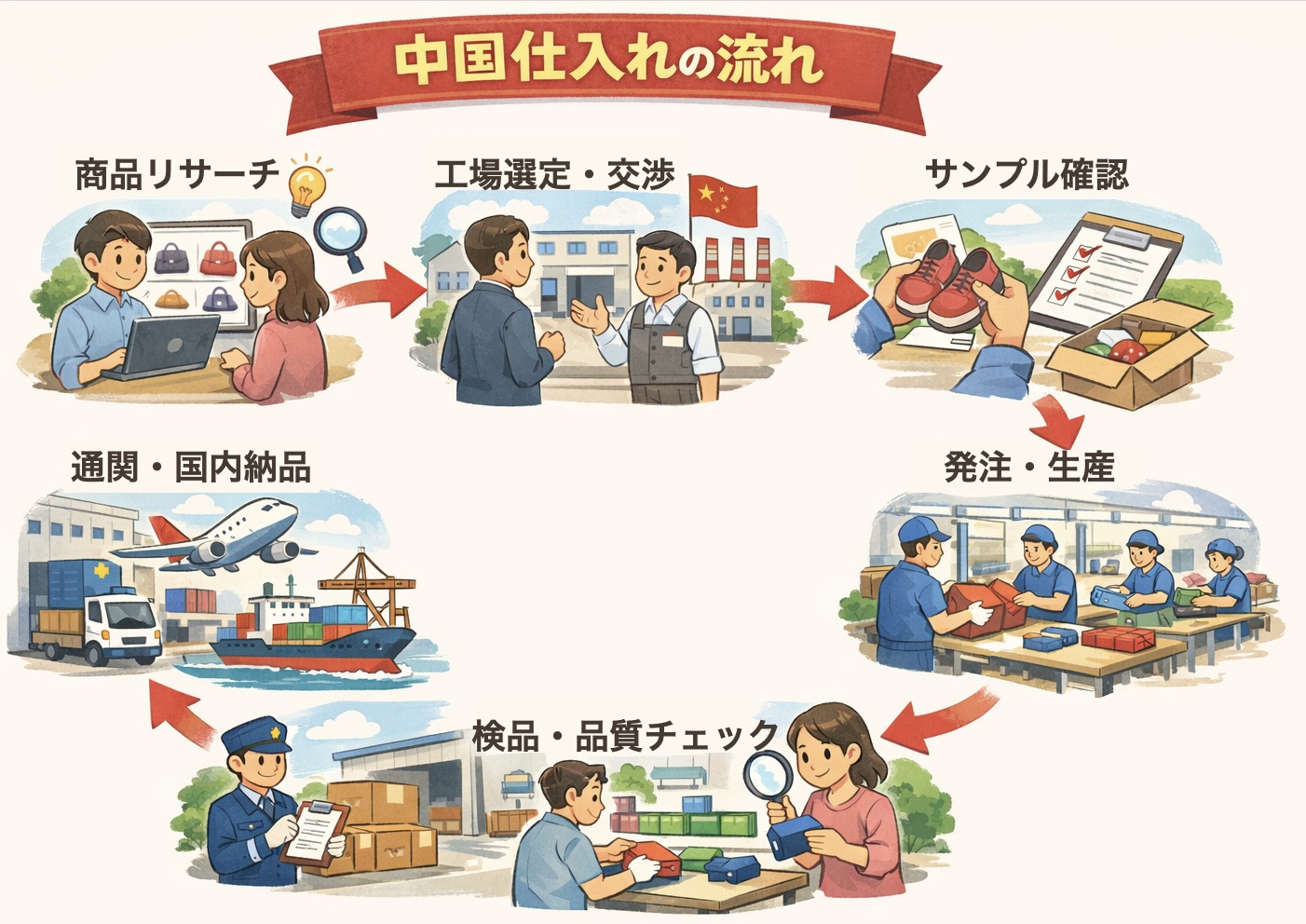
This is because sourcing from China is not simply “the act of buying goods,” but rather “a project involving multiple interconnected processes.”
More accurately, it is a series of interconnected steps, such as:
・Product planning and requirement definition
・Supplier search
・Quotation and negotiation of terms
・Sample production and verification
・Mass production contracts and ordering
・Mass Production and Quality Control
・Inspection and packaging
・International logistics arrangements
・Customs clearance and regulatory compliance
・Receipt in Japan and Sales Preparation
If your understanding of even one of these areas is unclear, you will end up paying the price for it in the subsequent stages.
Step 1: Product Planning and Requirement Definition
80% of Sourcing from China Is Decided "Here"
The initial design phase is the most overlooked yet most critical aspect of sourcing from China.
The following decisions must be made at this stage:
・Which market
・For whom
・At what price
・In what condition
If you proceed without clarifying these points, there will inevitably be a misalignment in understanding with the factory.
One point to be especially careful about is that the notion of “what’s standard in Japan” simply does not apply here.
For example
・Sewing precision
・Acceptable color variations
・Package finish
・Inclusion of accessories
These are conditions that do not exist unless they are articulated.
Step 2: Supplier Search
"Discerning" Rather Than "Finding"
Chinese B2B platforms like Alibaba and 1688 are frequently used during the product search phase.
However, what matters here isn’t “whether the product exists,” but “who is making it.”
When it comes to Chinese sellers,
・Actual factories
・Trading companies
・Brokers
・Businesses with only photos
.
Even if products look the same,
・Management systems
・Quality standards
・Response speed
can vary significantly.
Step 3: Negotiating Quotes and Terms
Why You Shouldn't Just Look at the Price
When getting quotes, many people think this way.
"I’ll go with the cheapest option."
However, when sourcing from China, the quoted price does not equal the final cost.
Items to check at the quotation stage include:
・Minimum order quantity
・What is included in the unit price
・Whether mold and plate costs are included
・Availability of quality inspection services
・Terms for handling defective products
It is particularly important to clarify “what is included in the price.”
If you proceed without confirming this, additional costs will arise one after another later on.
Step 4: Sample Production and Review
A sample does not guarantee mass production
The most common misconception when sourcing from China is the belief that if the sample is good, the mass-produced product will be the same.
In reality, samples
・Skilled staff
・Take time
・with no regard for cost
.
In other words, samples represent the “best possible result,” while mass production represents the “average result.”
What’s important at this stage is
・Deciding what constitutes an “OK”
・What constitutes a failure
.
Step 5: Mass Production Contract and Order Placement
The risks of not signing a contract are greater than you might think
Ideally, before entering mass production,
・Specifications
・Quality standards
・Delivery schedule
・Scope of liability in case of defects
.
However, in reality, it is not uncommon for orders to proceed based solely on chat messages.
As a result, disputes such as “he said, she said” or “we never agreed to that” frequently arise.
Step 6: Mass Production and Quality Control
Leaving it entirely up to the factory is the most dangerous approach
Once mass production begins, many people feel reassured.
However, in reality, this is where the highest risks lie.
・Material changes
・Process simplification
・Personnel changes
These changes can occur at the factory’s discretion.
Quality is not something to be “hoped for”; it is something to be managed.
Step 7: Inspection and Packaging
Whether it can be stopped before shipment
If defective products are discovered after they arrive in Japan, the damage can escalate rapidly.
That is why pre-shipment inspection is so important.
・Appearance
・Quantity
・Specifications
・Functionality
Whether we can catch problems at this stage is what separates profit from loss.
Step 8: Arranging International Shipping
Shipping costs are determined by "conditions," not "distance"
International shipping costs are not determined by simple distance.
・Weight
・Volume
・Packaging type
・Product attributes
It is determined by a combination of these factors.
In particular, prior confirmation is essential for items such as batteries, liquids, and magnetic materials.
Step 9: Customs Clearance and Compliance with Legal Regulations
The Difference Between Those Who Get Stopped and Those Who Don't
The reason people get stopped at customs isn’t bad luck—it’s the system.
・Document discrepancies
・Items subject to legal regulations
・Reasonable pricing
・Past history
These factors are evaluated in combination.
Step 10: Receipt and Preparation for Sale in Japan
Purchasing is complete only when the product is ready to sell
The purchasing process isn’t complete just because the merchandise has arrived.
・Re-inspection
・Labeling
・Packaging
・Product listing
Only after everything is ready for sale is the process truly complete.
In Closing
Sourcing from China isn't just about "knowing how to buy cheaply."
It is the ability to understand the overall process and grasp what is happening at each stage.
Instead of focusing on partial optimization, you must view the entire process—from start to finish—as a single, continuous flow.
When you can do that, sourcing from China ceases to be a risk and becomes a repeatable business strategy.