What is naphtha?
Naphtha is a type of petrochemical feedstock produced during the refining of crude oil.
Naphtha is used as a base material for petrochemical products and it is used to make a wide variety of materials, including plastics, synthetic fibers, resins and chemical products.
In other words, many of the products we use in our daily lives are indirectly related to naphtha.
・Storage cases
・Smartphone accessories
・PVC products
・Acrylic goods
・Packaging materials
These items often use naphtha-derived materials and are therefore highly susceptible to fluctuations in naphtha prices.
Therefore, when naphtha prices rise, raw material and manufacturing costs tend to increase as well.
What is the Naphtha Shock?
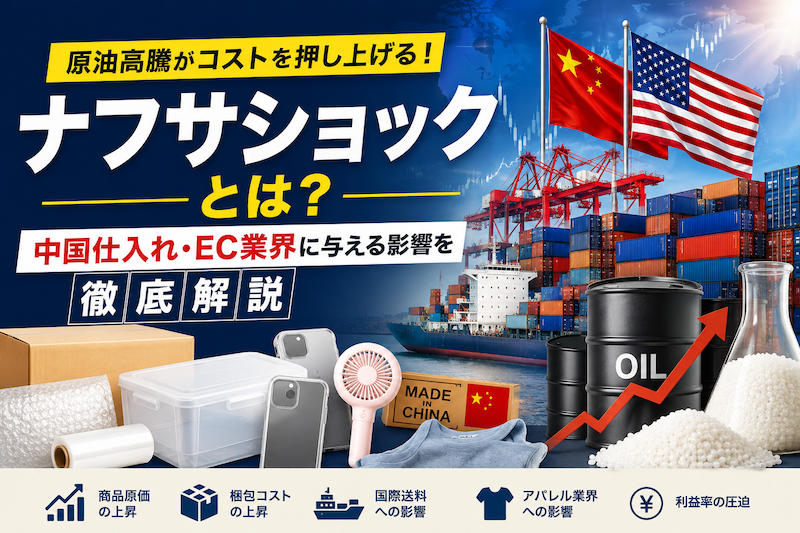
Recently, there has been an increasing tendency to use the term “naphtha shock” as a straightforward way to describe the situation in which rising naphtha prices are having a widespread impact on manufacturing and logistics costs.
In particular, For industries that use large amounts of plastics and chemical materials, rising raw material prices tend to have a direct impact on product costs.
The underlying factors include:
・Soaring crude oil prices
・Deteriorating conditions in the Middle East
・Disruptions in maritime transport
・Global inflation
・Currency fluctuations and others.
Furthermore, recent instabilities in logistics and energy prices has made manufacturing costs at Chinese factories more prone to increase.
Since China is home to such a high concentration of manufacturing that it is often called the “world’s factory,” fluctuations in naphtha prices could significantly impact sourcing from China and OEM production.
How will the naphtha shock affect sourcing from China?
・Rising cost of goods sold
The biggest impact, as expected, is on the cost of goods.
For example, Plastic cases, PVC bags, synthetic,fiber apparel, acrylic products, and household goods are prime examples of products highly susceptible to fluctuations in raw material prices. Since manufacturers also need to maintain their profits, there are increasing cases where “purchase prices have risen compared to before.”E-commerce businesses dealing in low-priced items, in particular, are prone to seeing their profit margins squeezed.
・Rising packaging costs
An often-overlooked factor is the impact on packaging materials. In e-commerce sales,
・OPP bags
・Shipping bags
・Air cushions
・Tape
・Cardboard boxes and other items in large quantities.
Since many of these are made from petroleum-based materials, this sector is particularly susceptible to rising naphtha prices. In other words, not only product prices but also "shipping costs”may rise.
・Impacts on The International Shipping Costs
When crude oil prices rise, it tends to affect the cost of fuel used for sea and air freight. As a result, fuel surcharges and transportation costs may increase, which can lead to higher international shipping rates.
However, logistics costs are not solely determined by crude oil prices.
In reality,
・Container supply and demand
・Port congestion
・Route changes
・International political and economic conditions
・Exchange rate fluctuations and other factors.
Recently, in particular, the situation in the Red Sea and global logistics disruptions have led to a prolonged period of instability in shipping costs. For businesses importing from China, many calculate profits on a “shipping included” basis, making these fluctuations a significant issue.
Recently, it is not uncommon for shipping costs to exceed the product price itself, especially for low-priced items. Therefore, moving forward, it will be important not only to simply search for “cheap products” but also to design profit margins that include shipping costs.
In particular, small, lightweight products that are easier to maintain a profit margin on are likely to become even more important in the future.
The impact on the apparel industry is also significant
While naphtha is often associated with plastics, it is actually used as a raw material for a wide range of petrochemical products, including plastics and synthetic fibers.
In the apparel industry in particular, polyester, nylon and acrylic are all derived from petroleum.
Recent fashion products frequently use synthetic fibers due to their functionality and affordability.
Therefore, when naphtha prices rise, Fabric prices, Prices of auxiliary materials and Manufacturing costs are also likely to rise.
Cost management will become even more critical for businesses engaged in OEM production.
Will changes in U.S.-China relations have an impact?
Recently, attention has been focused on changes in U.S.-China relations and future policy toward China.
In particular, some observers are expressing concern that President Trump’s visit to China and developments in U.S. policy toward China could lead to changes in the logistics environment and tariff policies.
If U.S.-China relations move towards greater stability in the future, this could lead to greater stability in the Chinese economy and international logistics. As a result, there may be situations where improvements in the maritime transport and trade environments can be expected.
On the other hand, since U.S.-China relations involve multiple factors such as politics, economics and security, there are many uncertainties, and it is not certain that the situation will improve significantly in the short term.
Furthermore, depending on changes in tariff policies, export restrictions and the international situation, logistics costs and the import environment could conversely become unstable.
Therefore, rather than assuming that “things will settle down eventually,” it is crucial for importers to plan their profit margins and manage inventory based on the premise that “fluctuation risks may persist.”
What Chinese Importers Should Be Doing Right Now
・Review profit margins
The first priority is to review your current profit structure.
If you stick with your previous pricing, increased shipping costs, rising material costs, higher advertising expenses and increased packaging costs, you may have significantly reduced profits, especially when selling on Amazon, FBA fees, advertising costs and return costs are also factored in, so profits may be lower than expected. It is important to recalculate your profits based on the latest costs.
・The importance of lightweight and high-margin products is on the increase
Going forward, “small, light, and high-margin” products may become more advantageous than "large, heavy and low-cost”ones.
For example, accessories, beauty accessories, smartphone accessories, fan merchandise and OEM small items are categories where it's easy to keep shipping costs low. Small items are particularly well-suited for platforms like TikTok Shop and live commerce, so demand is likely to grow even further in the future.
・A small-batch strategy is key
In an era of unstable costs and shipping fees,“large inventories”can sometimes become a risk. In the past, the general mindset was that “buying in bulk is cheaper.”
However, given certain circumstances such as price fluctuations, shifts in trends and changes in sales performance are occurring at an extremely rapid pace.
Therefore, moving forward, order small batches, test product turnovers and test sales
It is precisely during the naphtha shock era that procurement partners like "HubBuyer" become essential
Due to the naphtha shock, fluctuations in production and logistics costs are likely to become even more significant going forward.
The days when "buying cheaply guarantees a profit" are gradually coming to an end, especially when importing from China, the final profit margin can vary significantly depending on price differences between factories, shipping terms, minimum order quantities and inspection accuracy.
Furthermore, in recent times, rising raw material prices, soaring international shipping costs and exchange rate fluctuations have made the procurement environment itself increasingly unstable.
That is precisely why, moving forward, it will be crucial to plan not only "which products to source" but also "how to source them.”
For example, at The HubBuyer Platform's small-lot sourcing/OEM consultations, factory negotiations/quality inspection support, logistics optimization and more, provides comprehensive support for sourcing from China, especially during periods of fluctuating raw material prices and logistics costs, such as the naphtha shock.
It is crucial to adopt a mindset of "designing your procurement strategy by working on your cost price.”
For example: avoiding large items prone to skyrocketing shipping costs, increasing the proportion of lightweight items, minimizing
inventory risk with small batches and increasing OEM products that are easier to maintain profit margins. It is essential and highly beneficial to think strategically from the procurement stage.
At HubBuyer, we prioritize “sourcing from China with sales in mind” rather than simply acting as a purchasing agent, making our services even more vital in times of significant cost fluctuations like those we've seen recently.
In e-commerce in particular, there is an increasing number of cases where“sales are growing but profits are not.”The cause is not limited to product costs alone. There are equally causes such as:
Rising shipping costs, increased packaging costs, soaring, advertising expenses, exchange rate fluctuations, return costs and other hidden costs are gradually eroding profits.
That is precisely why, moving forward, it will become increasingly important to develop a comprehensive strategy that considers not just“sourcing at low prices,” but also “how much profit remains in the end.”
Summary
The naphtha shock is not merely an issue for the chemical industry alone.
For businesses engaged in imports from China, OEM manufacturing and e-commerce sales, it is a critical issue that affects product costs, packaging expenses, logistics fees and ultimately, profit margins. Recently, in particular, with rising crude oil prices, soaring logistics costs and exchange rate fluctuations all converging, there has been an increase in cases where“sales are growing but profits are hard to come by.”
The days when "buying cheaply guarantees profit" are gradually coming to an end.
That is why, moving forward, it will be crucial to focus not only on "how cheaply we can source goods,” but also on“how much profit we can ultimately retain.”
For example, it is becoming necessary to adopt a mindset of profit planning from the procurement stage itself—such as increasing the proportion of lightweight products to reduce shipping costs, minimizing inventory risk by purchasing in small batches or avoiding price competition through OEM partnerships.
In e-commerce sales in particular, hidden costs—such as advertising, packaging, returns and FBA fees—have a significant impact on profits, not just the cost of goods sold.
Therefore, moving forward, it will become even more important not just to “find products that sell,” but to “create a structure that generates profit.”
Precisely because we are living in an era of rapid change, businesses that can adapt flexibly to market conditions may find it easier to generate stable profits.