How Should the Japanese Archipelago Address Earthquake Risks?
Japan is widely known as a "country prone to earthquakes," and its citizens live their daily lives while constantly facing the risk of earthquakes.
In the past, large-scale earthquakes such as the Great Hanshin-Awaji Earthquake (1995) and the Great East Japan Earthquake (2011) caused extensive damage, and more recently, the 2024 Noto Peninsula Earthquake also had a severe impact.
Such disasters not only cause building collapses and tsunamis but also lead to the “shutdown of daily life” due to the disruption of infrastructure such as electricity, water, and communications.
The 72 hours following a disaster are often referred to as the “time to save lives,” making preparations for self-reliance and mutual aid during peacetime even more critical.
Impact on Inbound Tourism? “Earthquake Rumors” Spreading on Social Media
In July 2025, rumors that “a major earthquake will strike Japan” spread widely on social media in Hong Kong.
It all started with a statement by a renowned feng shui master claiming that “a major earthquake will strike Japan in July,” which was widely covered on social media and by local media.
This information sparked widespread anxiety, leading to a wave of travel cancellations to Japan and leaving travel agencies scrambling to handle the situation.
Although the rumor had absolutely no scientific basis, it serves as a real-world example of how the emotion of “anxiety” can influence social behavior.
On the other hand, such incidents also serve as an opportunity to raise awareness about disaster preparedness.
Growing "Disaster Preparedness Awareness" and Changes in Consumer Behavior
In Japan, interest in disaster preparedness surges every time there is news coverage of an earthquake.
In recent years in particular, the need for “minimum stockpiles” has become recognized not only in households but also in businesses and public facilities, and awareness of preparedness has become widespread.
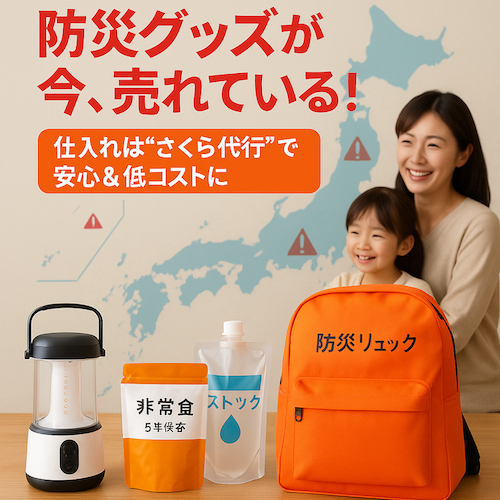
Not only local governments and schools, but also the e-commerce market has seen an increase in special features such as “Disaster Preparedness Goods” and “5-Piece Home Preparedness Sets,” leading many people to think about disaster preparedness on a daily basis.
This shift in behavior can be seen as a move based on the premise that disasters “will inevitably happen,” rather than simply preparing “just in case.”
In particular, among families with children and elderly households, there is a growing trend of people purchasing supplies with the goal of maintaining “at least a three-day stockpile.”
Types of Disaster Preparedness Supplies and Market Trends
Currently, the main items attracting attention as disaster preparedness supplies are as follows:
・Hand-crank radios & lights (with mobile phone charging function)
・Long-shelf-life emergency food (5-year shelf life, no heating required)
・Foldable portable toilets
・Portable sleeping bags and thermal blankets
・Stretchable water storage bags
・Helmet and disaster-preparedness hood
・Solar-powered LED lanterns
While these items are commonly stocked for household use, many companies and facilities also adopt them as disaster preparedness kits. Bulk purchases by corporations are particularly active around the end of the year and the fiscal year-end.
Furthermore, in recent years, products that combine functionality and design for everyday use—such as “stylish disaster preparedness backpacks” and “emergency food that blends in with home decor”—have emerged, leading to increasingly diverse consumer interests.
Where and how should you stock up on disaster preparedness supplies?
Disaster preparedness supplies can be easily purchased through domestic home improvement stores and major e-commerce sites.
However, challenges such as high cost ratios and difficulty in differentiating products often result in limited profit margins in this highly competitive market.
On the other hand, sourcing from overseas—particularly from China—offers significant advantages.
China is home to numerous manufacturing hubs for disaster preparedness products, and B2B platforms such as 1688.com and Taobao feature a wide variety of products offering excellent value for money.
With an extensive variety of products available, these platforms are ideal for building a unique product lineup.
However, sourcing from overseas involves several hurdles, such as the "language barrier," "quality control," "price negotiation," "international shipping," and "customs clearance."
The role of a “China import agent” is to comprehensively resolve these challenges.
Use HubBuyer to source high-quality disaster preparedness supplies from China!
"HubBuyer" is a sourcing agency specializing in imports from China, offering a comprehensive range of services—from sourcing via 1688 and Taobao to OEM support, quality inspection, international shipping, and customs clearance assistance.
Even for products that require high standards of quality and safety, such as disaster preparedness supplies, you can purchase with confidence because we offer on-site product verification and inspection services.
We particularly recommend this service for:
・Individual e-commerce sellers who want to start with small orders
・Those who want to create their own "original disaster preparedness kits"
・Those looking to reduce costs for bulk purchases for corporate clients
・Those who want to sell product bundles combining multiple items
Since we also offer OEM services, we can flexibly accommodate requests such as “disaster preparedness backpacks with your original logo” or “custom-engraved LED lights for promotional use.”
[Case Study] These Are the Disaster Preparedness Items That Are Actually Selling!
For example, the following disaster preparedness items sold on Amazon can achieve high profit margins when sourced from China.
① Multifunctional Solar Light (Hand-crank & USB charging compatible)
・Amazon selling price: 2,780 yen
・Sourcing price from China (1688): Approx. 975 yen
・Estimated Profit: Approx. 1,800 yen/unit (*Excluding international shipping, FBA fees, etc.)
② Disaster Preparedness Backpack (Single Item)
・Amazon selling price: 2,070 yen
・Purchase price in China: Approx. 650 yen (may vary depending on contents)
・Estimated profit: 1,400 yen or more per unit (excluding international shipping, FBA fees, etc.)
As shown above, with the right sourcing strategies and planning, it is possible to develop high-priced, high-margin product lines.
Furthermore, since disaster preparedness goods serve a social purpose—protecting people’s lives and livelihoods—you can implement marketing strategies that go beyond simple product sales.
As products that address social issues, they are easy to incorporate into B2B proposals with companies and local governments, making this a field where you can build a competitive advantage in terms of branding.
Now is the perfect time to start stocking up! We’re entering an era where preparing for the unexpected translates into products that sell.
With growing awareness of the need to prepare for “just in case” scenarios, disaster preparedness supplies are more than just products.
They are “peace of mind itself,” designed to ease people’s anxieties and protect lives.
For example—
“I have children, so I want to make sure I have the bare minimum of supplies.”
• “I want to stock up on supplies to ensure the safety of my employees.”
• “I want to send some to family members who live far away”
Products that cater to these sentiments carry a significant mission and meaning for us as sellers.
Disaster preparedness goods are products that allow us to contribute to society by “providing preparedness” rather than simply pursuing profit.
Going forward, sales channels are likely to diversify further, including cross-border e-commerce, the “Furusato Nozei” tax donation program, and stockpiling proposals for corporations.
Because these are products that resonate with people and meet a real need, this is a business sector well worth pursuing over the long term.
Summary: From sourcing to sales, you can rest assured knowing that “HubBuyer” handles everything
In a country where the risk of earthquakes is ever-present, we are called upon to be “prepared” for disasters that could strike at any time.
And now, we are in an era where there is great value in becoming a “support provider” who helps those “prepared individuals.”
By utilizing HubBuyer, you can make the procurement of disaster preparedness supplies easier, more flexible, and evolve it into a more profitable business.
― What HubBuyer Can Do ―
・Supports small-lot purchases: Orders can be placed starting from the minimum quantity
・On-site inspection and product photography services: Ensures quality control and provides product images
・Automatically estimates the lowest international shipping rates: Understand costs before purchasing
・Comprehensive support for customs clearance and import concerns: Leave the paperwork to us for peace of mind
Today, selling disaster preparedness supplies is more than just a business—it’s an effort to bring peace of mind to society.
Take the first step toward turning “preparedness” into “valuable products”—
Why not take that first step right now with “HubBuyer”?