Foreword
Sourcing from China is not a "Business Where Speed Determines Success or Failure”
When people think of sourcing from China, they often associate it with the idea that“production can start immediately”or that “large quantities can be procured at low prices.”
However, in actual business practice, sourcing from China is a process that relies on repeated confirmation, adjustments and judgment to succeed.
If one attempts to achieve results in the short term, they are forced to skip processes that should have been completed in advance.
Yet in sourcing from China, these steps—which are easily overlooked—are precisely the most critical elements underpinning quality, documentation, customs clearance and accountability.
Rather than starting from vague theories, this article will examine the structure of sourcing in China itself to analyze why "a blind pursuit of speed often leads to failure.”
When we say “get results as soon as possible,” what exactly are we leaving out?
If you want to achieve results in the short term, you’ll have to skip certain steps.
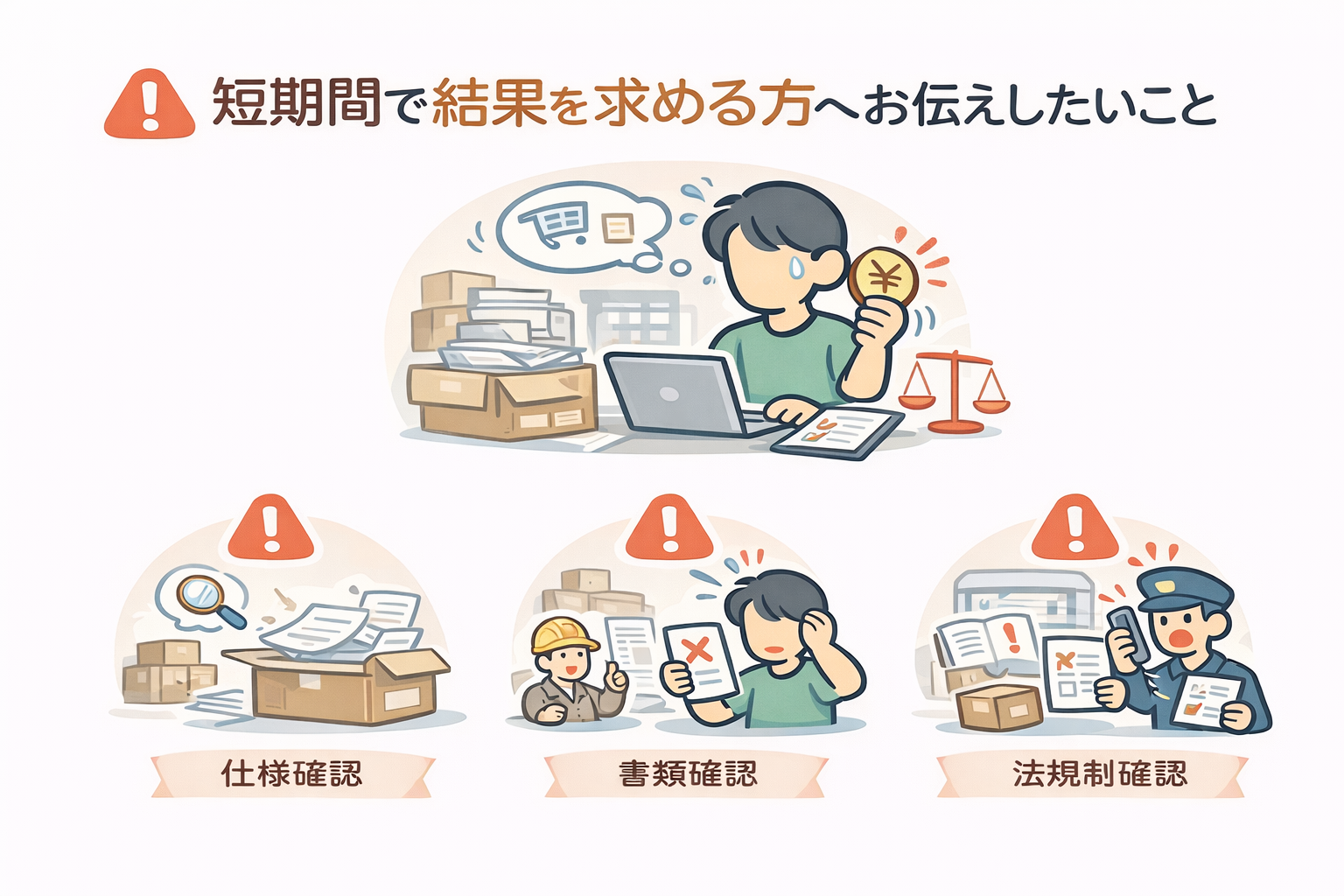
In practice, the steps most likely to be omitted at this stage are the following:
・Verifying specifications
・Sample verification
・Careful review of documentation
・Regulatory compliance checks
These are all steps that, when carried out in advance, help prevent problems.
However, because these tasks do not directly produce visible results, it is easy to think, “We can do this later.”
The so-called “racing against the clock” actually creates a mechanism that deliberately delays addressing these problem-prone steps.
As a result, even if progress appears rapid on the surface, large-scale revisions or work stoppages are likely to occur later on.
When sourcing from China, it’s difficult to make “mid-process changes.”
When sourcing or selling off-the-shelf products domestically, even if problems arise, they can sometimes be corrected along the way.
On the other hand, when sourcing in China—particularly for OEM or private-label products—making adjustments midway through the process becomes extremely difficult.
Specifically,
・Specifications cannot be changed once mass production has begun
・Contents cannot be modified once documentation has been finalized
・Shipping cannot be halted once it has begun
The procurement process in China follows a sequential structure where each step is finalized one after another; once a step is completed, it is impossible to go back to the previous one.
Consequently, the more one attempts to push a project forward in a short timeframe, the more “point-of-no-return” decisions must be made in the early stages.
As a result, when insufficient verification or misjudgments occur, they are often not resolved through “corrections” but tend to escalate into situations where “problems come to light.”
Reasons Why Short-Sighted Thinking Leads to Document Issues
The more a project needs to be pushed forward in the short term, the more likely it is that document reviews will be put on hold.
・Product name is tentative
・Quantity to be adjusted later
・Proceed with this price for now
Once such decisions accumulate, they can lead to discrepancies between the documentation and the actual goods.
For customs authorities, the key issue is not “whether it is urgent,”
but rather whether the information can be explained consistently from start to finish.
Documents prepared hastily due to short-term thinking are often submitted before the underlying assumptions have been clarified, making it difficult to provide a reasonable explanation.
As a result, such declarations are often flagged as requiring verification or correction, which can easily lead to clearance issues.
Laws and regulations do not take scheduling into account.
“Want to sell it as soon as possible,” “Want to take advantage of a promotion”
Even in these situations, laws, regulations and certification standards will not be relaxed.
PSE certification, labeling requirements, food-related regulations and other requirements must be met at the time of import.
Even when time is tight, verification and procedures must not be omitted.
If, in an attempt to expedite the process,
・Failure to complete the necessary inspections in a timely manner
・Inability to prepare all required documents by the deadline
・or even selecting products for which import procedures cannot be processed at all
such problems are all too common.
Legal and regulatory criteria are not based on a business operator’s specific circumstances or sales plans but solely on whether the requirements are met.
Scheduling that ignores this premise is unlikely to work in procurement in China.
The more people want to see results in the short term, the more simplistic their judgment becomes.
When time is tight, the information available to support decision-making naturally becomes more limited.
In most cases, people tend to make decisions based solely on whether something is “the cheapest” or “the fastest.”
However, when sourcing in China, the focus should actually be on:
・Whether the quality is consistent
・Whether a reasonable explanation can be provided to customs and the seller
・Whether purchases can be made consistently under the same terms
These factors must also be taken into account simultaneously.
The more one tries to achieve results in the short term, the more these judgment criteria are undermined, with an overemphasis on immediate numbers and speed.
As a result, a structure emerges in which “long-term risks and irreparable problems are excluded from the decision-making process.”
In procurement in China, the more simplified the decision-making process becomes, the more likely it is that irreversible choices will be made afterward.
The mindset that “as long as things go smoothly for now, that’s all that matters” won’t work.
When sourcing from China, the mindset of “as long as customs clearance goes smoothly this time, that’s good enough” doesn’t always hold true.
This is because,
・Import records
・Whether there have been any amended declarations
・Details of past disputes
All of this information can influence future import approval decisions.
If you push ahead for short-term gains, even if customs clearance goes smoothly this time, future inspections may become stricter or you may be asked to provide more detailed explanations.
As a result, it is not uncommon for subsequent procurement to become difficult to proceed with, ultimately leading to greater time and cost expenditures.
Sourcing from China is not a one-time transaction but a process in which transaction records are continuously accumulated.
This structure dictates that the more one prioritizes short-term success, the more one’s options will be limited in the medium to long term.
Communication Breakdowns Caused by Short-Term Thinking
The more urgent a project is, the more likely communication is to be oversimplified.
・Key details were not adequately communicated
・Moving forward when prerequisites are still unclear
・Ignoring cognitive biases
When sourcing from China, the risks associated with this situation are particularly high.
Due to barriers such as language, culture and distance involved in sourcing from China, it is essential to carefully verify the intentions and prerequisites of both parties.
If the process is driven by short-term gains, this verification step is often skipped because it is viewed as “time-consuming.”
As a result, subtle cognitive biases go uncorrected and continue to accumulate, eventually escalating into serious problems.
In procurement from China, prioritizing speed often goes hand in hand with a loss of communication accuracy.
If you still want to see results in the short term, this is a realistic option.
If results must be achieved in the short term no matter what, in some cases it makes more sense to consider alternatives to sourcing from China.
For example,
・Domestic procurement
・Reselling inventory
・Reselling existing inventory
Since the conditions and prerequisites for these approaches are already established, it is easier to expedite the process than when sourcing from China.
Seeking short-term results is not a problem in itself. The problem lies in choosing methods that do not align with the timeline.
If the goal is “quick results,” then choosing methods that align with that goal is the most realistic and lowest-risk decision.
Sourcing from China is not a sprint; it is a process that requires planning and gradual accumulation.
When time is of the essence, there is no need to insist on sourcing from China. This, too, is a sound decision.
Who is a good candidate for sourcing from China?
People who are suited to sourcing from China are those who hold the following mindset:
・Those who are willing to spend time verifying and making adjustments
・Do not mind encountering some setbacks in the early stages
・Those who wish to continue utilizing the established systems
People with this mindset tend to align more easily with the way procurement from China operates.
Sourcing from China is not a means to pursue short-term results, but rather a method to refine systems and achieve stable operations.
Therefore, it is better suited for those who prioritize sustainable, transparent business practices over immediate results.
Not rushing to achieve results can actually be a shortcut.
It is not uncommon for a process that seems like a detour to actually turn out to be the shortest path in practice.
・First, verify thoroughly
・Do not make hasty judgments
・Start by establishing a well-defined framework
These steps are all designed to prevent problems before they arise and avoid revisions, delays and issues that can easily occur later on.
In Chinese procurement, there are many decisions from which there is no turning back once they are implemented.
For this very reason, taking the time to carefully consider matters before moving forward ultimately becomes the fastest way to proceed.
An attitude of not rushing to achieve results does not mean sacrificing speed; rather, it is a choice made to avoid unnecessary delays.
Summary
There is nothing inherently wrong with seeking short-term results.
However, the reality is that when it comes to sourcing from China, this is not necessarily the most appropriate approach.
Sourcing from China is a process that requires repeated confirmation, adjustments and clarification to establish a solid framework.
If short-term results are prioritized, this can lead to a mismatch with this structure.
What truly needs to be prioritized is not the outcome but rather the sound judgment.
What exactly are you pursuing? Is sourcing from China truly the right approach for this goal?
If decisions are made after clarifying these issues, you can avoid pushing forward half-heartedly, which will ultimately lead to stable results.