Understanding AQL Inspection
What is AQL?
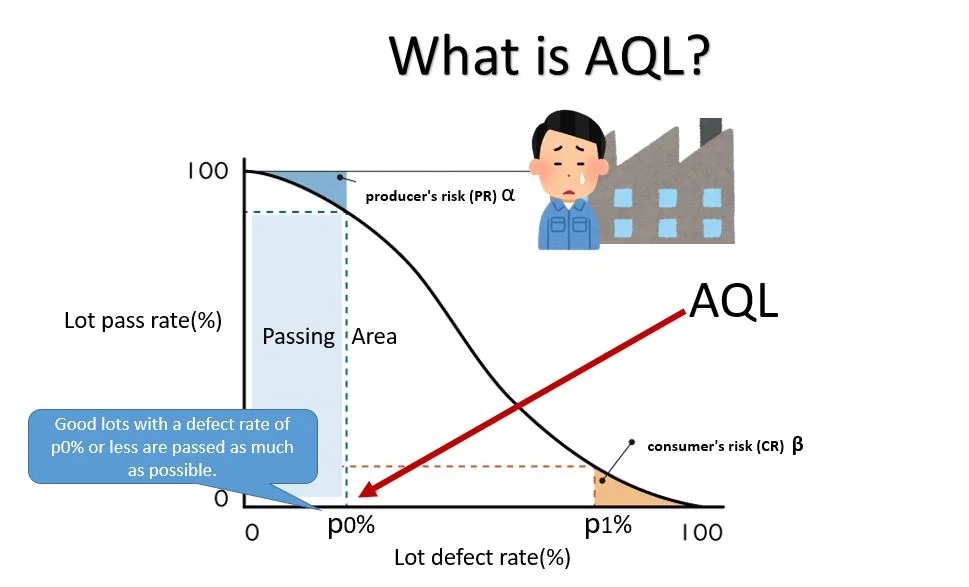
Acceptance Quality Limit is what AQL stands for. This is the number of defects in a batch of products that a buyer can accept from a sample. The standard for this is defined by ISO 2859-1. It says that AQL is the average percentage of defective items that are allowed when each batch of products is inspected.
- AQL is not really about saying it is okay to have defects in the products.
- It is more about having a way to make a decision on whether to accept or reject a product.
For example let us say you have a batch of 3,000 products. You might only check 200 of them to see what they are like. Then you use the number of defects you find in those 200 products to decide if you should accept the shipment of products or reject it. AQL helps you make this decision, about the products.
Why Use AQL Inspection?
AQL is really helpful for people who buy products because it helps them find a balance, between the time it takes the money it costs and the risks they take.
- Looking at every product is usually too costly and it takes a lot of time.
- AQL is useful because it lets product buyers decide what quality standards they want and it helps them find problems on.
- This means product buyers can fix problems at the factory where AQL is used and that is where it is cheaper to fix things so product buyers can use AQL to save money.
How Does AQL Sampling Work?
Here are the steps to follow: First you need to decide on the order quantity. This is the number of products that you want to check. The order quantity determines how many products to inspect. Next you have to choose an inspection level. You can pick from level I, level II or level III. You can even choose a special level. The special level is for testing that destroys products or takes a lot of time. Then you need to determine the sample size. To do this you use AQL tables to find out how many products to inspect. You use the AQL tables based on your order quantity and inspection level. After that you have to set quality standards. This means you decide what types of defects are critical what types of defects are major and what types of defects are minor. Next you randomly products, from your order. You choose products randomly. Then you inspect the products. You check each product against your quality standards. Finally you get the inspection result. You compare the number of defects to your limit. You do this to see if the products meet your quality standards. The inspection result is based on the order quantity and the inspection level you chose. You use the inspection result to decide what to do with the products.
Inspection Levels
The ISO 2859-1 standard has three levels: Level I, Level II and Level III. The ISO 2859-1 standard is used for inspections. It has these levels.
- Level II is what people usually use for checking things that are being shipped.
- You use Level I when you really trust the person or company that is sending you things.
- The ISO 2859-1 standard has a Level III. This is used when you need to be very careful, with the things you are getting.
Electronics Sourcing Tips
Buying electronics can be a risk because it involves a lot of complicated parts. You need to understand what kind of electronics you are looking to buy. It is very important to define what your product needs to be like clearly. You should know how Chinas electronics supply chain works because China is a player, in the electronics supply chain and knowing this will help you with your electronics sourcing and electronics sourcing is a crucial part of getting the right electronics.
Choosing the Right Sourcing Channel
You have a lot of options when it comes to buying things: Alibaba is one option, Made-in-China is another. Then there are the 1688 Huaqiangbei markets in Shenzhen. You can also go to trade fairs. Deal directly with factories or work with trading companies or use sourcing agents. When you are buying products you really need to be careful and evaluate them properly. Technical products, like these require evaluation.
Evaluating Suppliers
You should really verify the suppliers before you pay a deposit to them. The things you need to check are the supplier’s business licenses, the supplier’s production videos and the supplier’s certification documents.
Building Quality Control
Good quality control is really important. It includes a few things. Quality control has things like material inspection. We also do, in-process inspection during assembly of the product. Then we have aging or burn-in testing to make sure the product is good. We also do inspection of the products to check the quality of the products.
Understanding Certifications and Compliance
You have to make sure you are doing things right before you finish making something. This means you need to understand the rules where you are selling things like getting permission, from the FCC in the United States and the CE marking in the European Union.
Paying Attention to Batteries and Chargers
Batteries and chargers are really important to watch out for. We need to make sure we know what kind of batteries we are dealing with. This means we have to confirm the battery chemistry, the brand of the cells inside the battery and the protection circuits that are, in place to keep everything. Batteries and chargers can be very dangerous if we do not take the precautions. So it is crucial that we confirm the battery chemistry, the cell brand and the protection circuits of the batteries and chargers.
Planning Packaging, Labels and Manuals
When we buy something the packaging has to protect the products. It is also very important that the packaging communicates safety information to us. The manuals that come with the products should provide us with instructions, on how to use the products. The products and the packaging are very important because they have to work to keep us safe. The packaging of the products must protect the products and the manuals of the products should provide instructions.
Calculating the Real Landed Cost
The cost of something is not just about what you pay for it at the factory. There are a lot of things that add to the cost like making a mold or tool to produce the thing developing the firmware getting the necessary certification putting it in a package checking it to make sure it works shipping it paying duties, on it and helping the customer after they buy it.
Inspecting before Shipment
When we do an inspection before something is shipped we need to check a things. We have to make sure we have the quantity of the product. The product should also work like it is supposed to so we check its function. We have to check the quality of the product too. Higher-risk products need to be tested because they can be really important or maybe even dangerous if they do not work right.
Avoiding Common Electronics Sourcing Mistakes
When you are buying electronics you should not just think about the price. You have to consider the quality of the batteries. Electronics are things that need to be checked carefully. We need to make sure they are quality just like we do with other important products. The company that makes them should have records and checks to ensure that their electronics are safe and work well. This means looking at the quality of the batteries and other parts, not the price of the electronics.
Building a Long-Term Electronics Sourcing System
A good system has a list of suppliers records of what's in each product and folders with certificates. For each product that has been approved we keep a sample so that we know what the standard is. Electronics sourcing is not about getting the best price. It is about being careful and following rules. We need to have specifications check the suppliers test the samples review the certificates control the parts and check the products before they are shipped. This is especially important for products with batteries, wireless parts or things that get hot. A good supplier can tell us about the parts they use. How they test them. A good process for buying parts helps keep our customers safe. It helps us keep a good reputation.
AQL Criteria, Preparation and Inspection Results
These are the problems we might find with a product.
- Defects are serious problems that can hurt someone or break the law. Examples are wires that are not covered things inside the product that should not be there and missing safety marks. We do not accept any defects.
- Major problems are ones that affect how the product works, how it. If people will buy it. These can cause customers to return the product and complain. Examples are broken zippers, wrong size or color and big imperfections that you can see.
- Minor problems are usually small flaws that do not really affect how the product works. Examples are threads and small scratches that you can see.
What is a minor problem can be different depending on the product. For example a small scratch on the box might not be a deal but it would be a problem if it was on a luxury cosmetic product. The buyer needs to be very clear, about what they consider a minor problem.
Typical AQL settings for Product Buyers
The common settings used by Buyers sourcing many types of consumer products are:
- Critical Defects: 0
- Major Defects: 2.5
- Minor Defects: 4.0
However these settings are entirely dependent on product risk. If the risk to brand name is higher the client may choose to set the AQL limits
How to prepare for an AQL inspection
You need to give the inspector some papers. The inspector should always get a list of things to check when they do an AQL inspection. This list should have information from the purchase order and the specification documents and the master sample and the packaging and labelling requirements. You have to make sure the inspector has all these things so they can do their job properly. The master sample is very important for the AQL inspection. The packaging and labelling requirements are also very important, for the AQL inspection. The purchase order and the specification documents are part of the papers the inspector needs.
How to read an AQL inspection report
An inspection report will usually cover aspects such as:
- Date and location of inspection
- Sample size
- List of defects found (with photos and explanations)
- Checks of packaging and cartons
- Number of items that passed or failed according to defect type
- Decision on the batch (pass or fail) according to the AQL established prior to the inspection.
What to do if an inspection fails
- Identify whether defects are minor, major or critical.
- Examine whether all defects are concentrated in a few units or if they are evenly distributed across the samples.
- Identify if the defects are repairable.
- The buyer then has options:
AQL Limitations and Common Mistakes
What the Limitations of AQL Are for Buyers
AQL is not meant to be perfect. It does not mean that the goods will have zero defects. AQL relies on checking a part of the total goods so problems that are not easy to find might not be detected. This means that even if the goods pass the AQL test it is still possible that there are some problems, with them. AQL passing means you are more likely to get quality goods but it does not mean that the goods will be completely flawless. The AQL pass is a sign but AQL itself cannot guarantee that the goods will have zero defects.
When is AQL Inspection Not Sufficient?
Electronic goods need testing. This includes toys and children’s products. Cosmetic products also require testing. Products that come into contact with food and those using batteries or having Bluetooth or Wi-Fi functionality like devices also need to be tested. Here are some types of testing that may be required:
- Electrical Safety Testing is done to ensure devices are safe to use.
- Chemical Analysis Testing checks if products contain substances.
- Age grading for toys is important to ensure they are suitable, for children.
Common mistakes Buyers make with AQL inspections
When we are arranging inspections after the goods have shipped it can be a problem. This is because we sometimes give the inspection team instructions that're not clear or are missing some details. We need to use the AQL limits for each product and think about the risks that come with it. Just because one inspection shows that the product passed the AQL limits it does not mean that the quality will be good, in the future when we buy from the supplier. It is also not an idea to do the inspection before the products are fully made and packaged. Some people just look quickly at the inspection results without checking what defects were found which is not the right way to do it.
A Practical AQL Workflow for Buyers
We need to define the product specifications clearly. The product specifications have to be documented in detail so that everyone knows what we are looking for in the product. We have to approve a physical reference sample, which we call the “sample" to make sure it meets our requirements. Then we classify the defects into categories. The product specifications and "golden sample" help us do this. We have three categories for defects: major and minor defects. We set limits for what we consider quality these are called AQL limits and they have to be suitable for the product. The contract terms must clearly state what the AQL is, what the inspection level is and so on so that everyone is on the page. Once the goods are manufactured and packaged ready to be shipped we arrange for an inspection to take place. During the inspection we have to make sure that we can randomly check any carton or product no matter where it is, in the production run. We have to review the Inspection Report carefully looking at all the details and think about what it really means. If there are any problems we have to take action based on the results of the inspection. We also keep an eye on how each supplier's performing over time looking at the product specifications and inspection results to see if they are meeting our requirements. We monitor the performance of each supplier to make sure they are doing what they are supposed to do.
Conclusion
AQL inspection is a part of outsourcing that helps to cut down on risk. The AQL inspection process transforms the quality expectations into standards that can be measured and verified. This is not a guarantee. The AQL inspection is certainly a lot better than just trying things out and hoping for the best. The AQL inspection gives us a way to check the quality of things which's very important when we are outsourcing. By using AQL inspection we can make sure that the things we get are good enough and this reduces the risk of getting things. The AQL inspection is a help, in this process.
Related Articles
All articlesHotel and restaurant supplies sourcing from China
A Chinese OEM Stalled at the “First Sentence” Before Mass Production | Reasons for the Delay and Decision-Making Criteria

Should You Choose Domestic Sourcing or Sourcing from China? — Domestic Sourcing and Sourcing from China Are Not "Mutually Exclusive" —
How to Find Reliable Wholesale Suppliers in China