Introduction
Why We Specify Cases We Cannot Handle
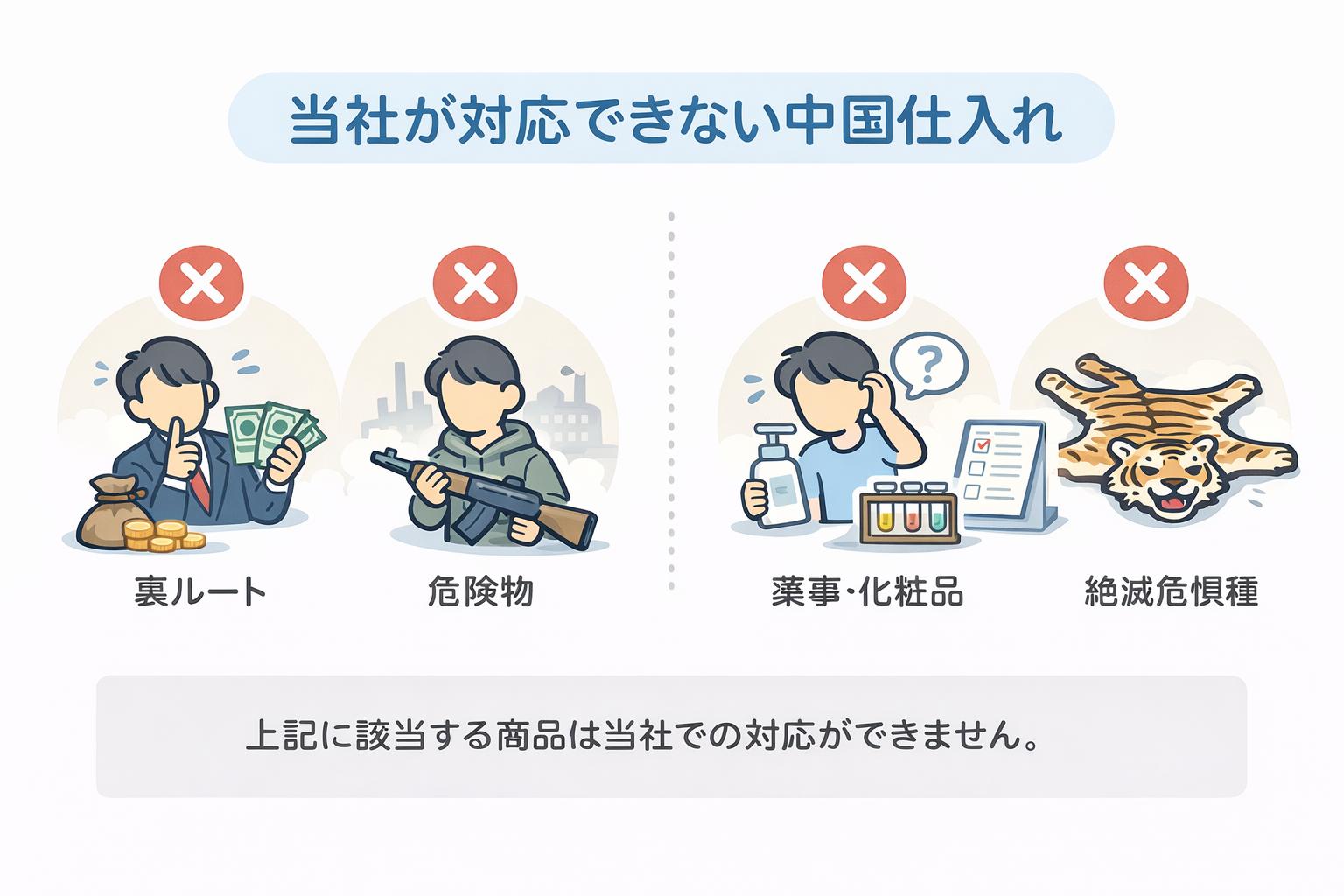
When sourcing from China, it is more important to determine “what not to handle” than “what can be handled.”
If you take on too much,
・Problems will arise
・We will be unable to explain the situation
・Ultimately, the customer will suffer
These are the consequences.
What matters is not whether we can handle it, but whether the project is structurally viable.
In this article, we will outline cases of sourcing from China that should not be pursued—not due to our company’s lack of capability or scope of services, but because of the inherent structure of the sourcing process itself.
Products that are difficult to import due to legal restrictions
When importing goods into Japan, there are certain products that face significant regulatory hurdles or are, in principle, impossible to import.
Typical examples include:
・Goods whose import is explicitly prohibited
・Products for which obtaining certification or permits is practically impossible
・Cases where, despite being subject to legal regulations, there is no intention or system in place to comply
These are not issues that can be resolved through the efforts of the factory or coordination with an agent.
Legal regulations are not "conditions that can be worked around with ingenuity," but rather prerequisites that must be met in order to import.
For products that cannot meet these prerequisites, we would ultimately be leaving our clients exposed to risk.
For this reason, we decline to handle such cases at this stage.
Purchasing with "low cost above all else" as the top priority
Prioritizing price is, in itself, a natural decision when purchasing inventory.
However, if you prioritize price above all else,
・Accuracy of documentation
・the actual condition of the goods
・Compliance with legal regulations
we cannot accommodate such purchasing practices.
This is because, in a system that prioritizes low cost,
・We cannot explain the contents of the documents
・Discrepancies between the actual product and the declared details
・It becomes impossible to make corrections later
such problems are likely to arise.
This is not because the price is low, but because the process proceeds without the necessary groundwork for decision-making.
As a result, this can lead to irreversible problems during customs clearance or sales.
Transactions based on the assumption that the documentation does not match the actual circumstances
We cannot assist with inquiries based on the following assumptions:
・You wish to declare information that differs from the actual product details
・You wish to make the price appear lower than it actually is
・You wish to intentionally obscure the intended use or purpose
These are not legitimate strategies for procurement or customs clearance.
They constitute acts that undermine the very basis of the declaration.
In transactions where the documentation does not match the actual circumstances, you cannot provide a consistent explanation to customs.
Furthermore, the importer is always ultimately responsible for providing an explanation.
We cannot be involved in transactions based on the premise that such accountability does not apply.
Cases where the purpose of the import has not been clearly defined
We are unable to assist with inquiries regarding the following situations:
・Is this a sales inquiry?
・Is it for sale?
・Is it for personal use?
If the purpose of importation is not clearly defined, we cannot plan the overall procurement process.
Unless the purpose is determined,
・Required documents
・Applicable laws and regulations
・Reasonableness of quantities and prices
cannot be determined.
Procurement carried out with an ambiguous objective is prone to decision-making breakdowns along the way, which can ultimately lead to customs clearance issues.
OEM and original products whose specifications have not yet been finalized
For OEM and original products, we cannot accommodate inquiries regarding mass production until the specifications have been finalized.
Specifically,
・The contents of the sample and the mass-produced product differ
・Specifications or materials are changed during the process
・Documentation cannot keep up with the changes
Under these circumstances, we cannot provide a valid explanation to customs at the time of import.
In OEM manufacturing, product specifications serve as the basis for customs declarations and documentation.
Proceeding while these premises are unstable will result in inconsistent explanations during customs clearance, leading to major problems.
Cases where the demarcation of responsibility cannot be accepted
When sourcing from China, no single party can shoulder all the decision-making and responsibility.
・Who makes the final decision?
・Who is accountable to customs and for sales?
If these lines of responsibility are not clearly defined, they will inevitably become an issue when problems arise.
In particular, requests made on the premise of “I want to leave everything to you” or “I want you to take full responsibility” result in an unclear decision-making authority.
The importer is always ultimately accountable.
We cannot handle cases where this premise is not accepted.
Purchasing based on the principles of short-term planning, quick decision-making, and immediate action
We cannot accommodate purchases under the following conditions:
・I want it shipped immediately
・Confirmation can wait
This approach, which prioritizes speed above all else, is not well-suited to sourcing from China.
When sourcing from China, there are essential steps that cannot be skipped, such as verifying specifications, reviewing documentation, and checking legal regulations.
Skipping these verification steps is what leads to customs clearance issues and quality problems down the line.
The problem isn’t moving quickly in and of itself. The problem is the assumption that you can proceed without verification.
"Post-incident support requests" (only after a problem has occurred)
Already,
・There are missing documents
・Held up at customs
・The underlying structure of the purchase has collapsed
In situations like these, where requests are made solely on the premise of “fixing things after the fact” with a “please do something” attitude, our ability to assist is limited.
This is because decisions regarding customs clearance and imports are made based entirely on assumptions established in advance.
Once these premises have been compromised, there are few options available for making adjustments afterward.
Purchasing is not something to be addressed after a problem arises; it is something that should be designed to prevent problems from occurring in the first place.
For projects that have proceeded without such planning, there are inherent limits to the support we can provide.
Saying “I can’t” isn’t just a way to say no
We clearly state in advance the cases we cannot handle, not to turn down requests.
Rather, it is to avoid from the outset a situation where, by pushing forward despite the challenges, the client would ultimately suffer a disadvantage.
When sourcing from China, there are many decisions that, once made, cannot be corrected later.
That is precisely why we make decisions based not only on what we can do, but also on what we cannot do.
We believe this is the approach that minimizes risk for our clients in the long run.
Criteria for Decision-Making, as Illustrated by Cases That Cannot Be Handled
There are several common factors in cases we are unable to handle.
・The explanation does not hold up
・The procurement structure is disorganized
・Responsibilities are unclear
Procurement efforts where these issues overlap are not only unlikely to succeed but also have a structure that is prone to problems.
Conversely, if these three points are properly addressed, sourcing from China is not as difficult as it might seem.
Understanding situations you cannot handle is also about knowing which failures to avoid.
Summary
Clearly defining boundaries is a form of risk management.
When sourcing from China, it is important to clearly define not only “what we can do,” but also “what we will not do.”
Cases we cannot handle are not a matter of capability or scope. They are cases we should avoid structurally.
If you proceed while leaving these boundaries ambiguous, you may appear to be making progress temporarily, but you will inevitably come to a halt at some point.
Conversely, sourcing conducted with a clear understanding of these boundaries is sustainable, justifiable, and leads to stable, long-term imports.
Don’t ask “Can we do this?”—ask “Should we proceed?”
That is the most realistic approach to risk management in sourcing from China.