What is personal import?
Personal import refers to the direct purchase by an individual of foreign products from overseas mail-order companies, retailers, manufacturers, or other entities for personal use; there is no legal definition of this term.
Japan Customs 3001 What is Personal Import? (Customs Answer)
The key point is that the goods must be "for personal use"; they cannot be sold or given to anyone else.
When importing goods for personal use, the following scenarios are possible:
1: Ordering directly from a foreign online retailer
2: Importing through an import agency such as HubBuyer
3: Shipping methods include EMS, Kuroneko Yamato International, Sagawa International, etc.
Taxation of Personal Imports
Personal imports are eligible for a preferential "duty-free" treatment. This does not apply to commercial imports.
1. Cases Eligible for Exemption
For goods with a taxable value (product price × 60%) of 10,000 yen or less, customs duties and import consumption tax are exempt.
In other words, for personal imports, as long as the base price of the product is 16,666 yen or less, both customs duties and import consumption tax are generally exempt.
For personal imports, overseas shipping costs and insurance premiums are not added to the taxable value, so you can determine whether the item qualifies for exemption based solely on the product price.
Summary: As a general rule, goods with a base price of 16,666 yen or less are exempt from customs duties and import consumption tax.
2. Exceptions to the Exemption
Leather bags, pantyhose and tights, gloves and footwear, ski boots, knitwear, and similar items are not eligible for duty exemption even if the dutiable value is 10,000 yen or less.
* Exemptions apply if the items are for personal use and were received as gifts.
3. Cases Subject to Taxation
If the value exceeds the exemption limit, you must pay customs duties.
The method of calculating customs duties varies depending on the total dutiable value.
If the total assessed value is 10,000 yen or more but 200,000 yen or less: Simplified tax rate
If the total dutiable value exceeds 200,000 yen: Actual tariff rate
Reference: Simplified Tariff Schedule (Excerpt)
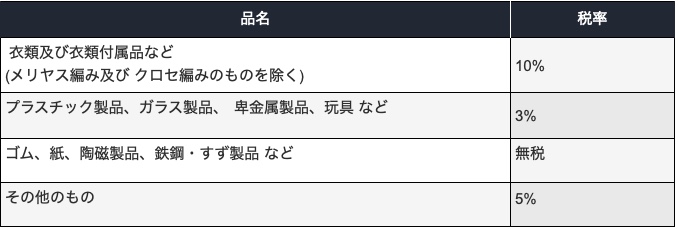
*If the tariff rate is zero, the customs duty will be 0 yen, but import consumption tax will still be levied.
Reference Article: Import Consumption Tax is Deductible.
*The simplified tariff rate is a simplified rate applied when clearing customs for small-value imported goods valued at 200,000 yen or less.
*The applicable tariff rate is the rate applied when the dutiable value exceeds 200,000 yen. Unlike the simplified rate, this rate is determined based on the standard classification of thousands of items.
4. Key Points for Customs Determination
While there are no set rules, the following factors may be considered:
1. Is the shipping address a corporate name or trade name?
2. Is the product price listed on the invoice abnormally low?
3. Is there a history of repeatedly importing the same product?
4. Does the quantity imported far exceed what is considered “for personal use”?
5. Is the product in a specialized field, and is it possible that an individual would use it?
What is commercial import?
Commercial import refers to imports made for the purpose of sale.
Even if the import involves a small quantity or a small amount, it is considered a commercial import if the purpose is to sell the goods.
For commercial imports, the taxable value is calculated as the product price plus shipping costs, optional fees, and insurance.
In the case of personal imports, only the product price is included, which is a significant difference.
The tax rate applied is the same as for personal imports.
If the total taxable value is between 10,000 yen and 200,000 yen: Simplified tax rate
If the total taxable value exceeds 200,000 yen: Actual tariff rate
*Importing samples for personal use is permitted as a personal import.
Sample Cost Estimates for Personal and Commercial Imports
Scenario 1: Product price: 10,000 yen
Setting 2: Various shipping costs + expenses for options, etc. + insurance = 5,000 yen
Scenario 3: 10% customs duty
・For personal imports
Taxable value: (10,000 × 0.6) = 6,000 yen
Customs duty: 6,000 × 10% = 600 yen
・For commercial imports
Taxable value: 10,000 + 5,000 = 15,000 yen
Customs duty: 15,000 × 10% = 1,500 yen
As you can see, there is a significant difference in the amount of customs duties between personal and commercial imports.
Summary
This article explains the differences between "personal imports" and "commercial imports" when importing goods from China, as well as how to calculate the associated customs duties.
To effectively "save on taxes," it is necessary to clearly understand these differences and use personal imports and commercial imports appropriately.
The content of this article was researched and compiled independently by HubBuyer.
We cannot guarantee the accuracy of this information, so please use it for reference only.
HubBuyer has offices in both Japan and China, and our mission is to handle all operations within China and deliver goods to Japan (including direct FBA shipping) on behalf of our business clients.
If you are considering importing and selling products from China, we encourage you to use HubBuyer’s services.