What Is Yiwu International Trade Market?
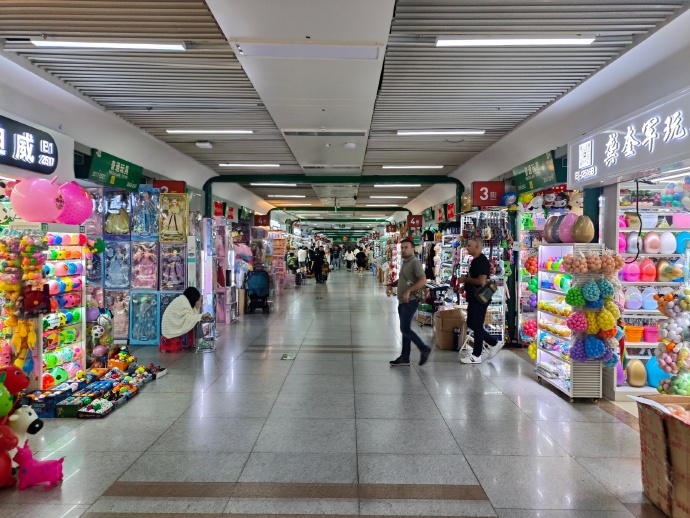
Located in Yiwu City, Zhejiang Province, China, the Yiwu International Trade Market is widely known as one of the largest wholesale markets in the world.
In Chinese, it is called “义乌国际商贸城 (Yìwū Guójì Shāngmàochéng)”, and it is filled wall-to-wall with products across all categories, including daily goods, general merchandise, and apparel.
In fact, this market was formerly known as “Futian Market.” Even today, many local people and industry professionals still commonly use the name “Futian Market.”
Although the official name has changed, it is important to remember that “Yiwu International Trade Market” and “Futian Market” refer to the same place.
Buyers from all over the world visit this market throughout the year, and international trade is actively conducted on a daily basis.
It is truly a place where you can grasp Chinese product trends in real time, making it an indispensable business hub for anyone involved in sourcing or product development.
The Astonishing Scale of the Yiwu Market
The most striking feature of the Yiwu International Trade Market is its overwhelming size and number of stores.
The total area exceeds 6.4 million square meters, and there are more than 75,000 permanent booths, a scale that fully lives up to its reputation as “world-class.”
So how long would it take to visit all of them?
A commonly cited estimate says that even if you spent three minutes per store and walked eight hours a day without breaks, it would take about one and a half years to see them all.
In reality, visitors who arrive without preparation are often overwhelmed by the size and volume of information and end up unable to find the products they are looking for.
That is why advance research and a clear visiting plan are absolutely essential.
Characteristics of the Five Districts
The Yiwu Market is divided into five main districts, each specializing in specific product categories.
By narrowing down which districts to visit based on your purpose, you can explore the market much more efficiently.
District 1
Main products: Decorations, accessories, toys, artificial flowers, stationery, gift items
Features: The oldest area of the market and very popular with beginners. Many shops accept small-lot orders, making flexible sourcing possible.
District 2
Main products: Daily necessities, hardware tools, kitchenware, small appliances, watches
Features: A wide range of everyday products. Prices and quality vary greatly, so on-site comparison is especially important.
District 3
Main products: Stationery, cosmetics, sports goods, travel items
Features: Many products emphasize design and practicality, making this district ideal for cross-border e-commerce and lifestyle goods stores.
District 4
Main products: Shoes, textiles, knitwear, hats, towels, lace, fabrics
Features: Well suited for apparel sourcing and OEM. Trend-driven and seasonal items are abundant, making it ideal for the fashion industry.
District 5
Main products: Imported goods, bedding, bicycle parts, auto parts, pet supplies
Features: More specialized products, attracting niche businesses and highly focused shops.
Each district has a clearly defined role, and selecting the right areas based on your business is the first step to successfully navigating the Yiwu Market.
Three Key Points to Improve Visiting and Sourcing Efficiency
To efficiently explore such a vast market, preparation is essential. Keeping the following three points in mind will help you avoid wasted time and unnecessary movement.
1) Clearly Define Your Target Products
For example, if you are looking for camping gear, tents may be in District 2 while outdoor accessories could be in District 3.
You must clearly define what you are looking for and under which category.
2) Set Priorities for the Areas You Will Visit
It is unrealistic to cover all districts in one day. Narrow down the areas based on the product categories you want to source and prioritize accordingly.
3) Decide the Visiting Order
The market layout is complex rather than linear, so planning an efficient route is essential.
Visiting adjacent districts in sequence helps avoid unnecessary movement.
Walking around aimlessly tends to drain both time and energy.
Thorough preparation and route optimization are the keys to successful sourcing.
What Is the “YiwuGo (义乌购)” App?
Before visiting the Yiwu Market, one highly recommended tool is the YiwuGo (义乌购) app.
With this app, you can check store information in advance, making your on-site visit much smoother.
You can view:
Store and product category searches
Booth numbers
Product images
Detailed supplier information
Translation functions from Chinese to other languages
By shortlisting relevant stores in advance, you can greatly reduce time loss and unnecessary movement on site.
Since network connections inside the market can be unstable, it is strongly recommended to save key information or take screenshots in advance using a stable Wi-Fi connection.
Safe for Beginners: HubBuyer’s Yiwu Market Escort Service
“I’m interested, but I don’t speak Chinese…”
“The market is too big—I don’t know where to start…”
For such concerns, we recommend using HubBuyer’s Yiwu Market Escort Service.
Service Details (Advance Reservation Required)
On-site accompaniment and interpretation by local staff
Route planning and scheduling based on prior consultation
Sourcing advice, negotiation support, and market price confirmation
On-the-spot quotations, OEM, logo printing, and packaging consultations
HubBuyer’s staff are bilingual professionals with deep knowledge of the Yiwu Market, so even first-time visitors can proceed with confidence.
Frequently Asked Questions (FAQ)
Q: Can you support visits even if I’m just looking around?
A: Yes. Even if your sourcing plans are not finalized, you can use the escort service for market research purposes.
Q: Is it difficult to rely only on the app?
A: The app is useful for basic research, but it has limitations.
Actual quality checks and detailed negotiations require direct, on-site communication. Many new or limited products are not listed online.
Q: Is the market open on weekends?
A: In principle, it is open year-round. However, weekdays are recommended, as some shops may close on weekends.
Q: How do I get to Yiwu?
A: Yiwu is accessible by high-speed rail from Shanghai or Hangzhou in about 1.5–2 hours.
From Yiwu Station to the market, it is about a 15-minute taxi ride.
Conclusion: How to Make the Most of the Yiwu Market
The Yiwu International Trade Market (commonly known as Futian Market) is truly a “real-world department store of Chinese products.”
The experience of seeing products with your own eyes, touching them, and negotiating directly is something that online sourcing can never fully replace.
However, to fully leverage this vast market, advance preparation, information gathering, and local support are essential.
Especially for first-time visitors, using HubBuyer’s escort service allows you to save time and costs while achieving efficient and meaningful sourcing.
For anyone looking to enter the China business market or expand sourcing routes, Futian Market is the perfect starting point.
Discoveries you cannot find online are waiting for you on site—see them with your own eyes.