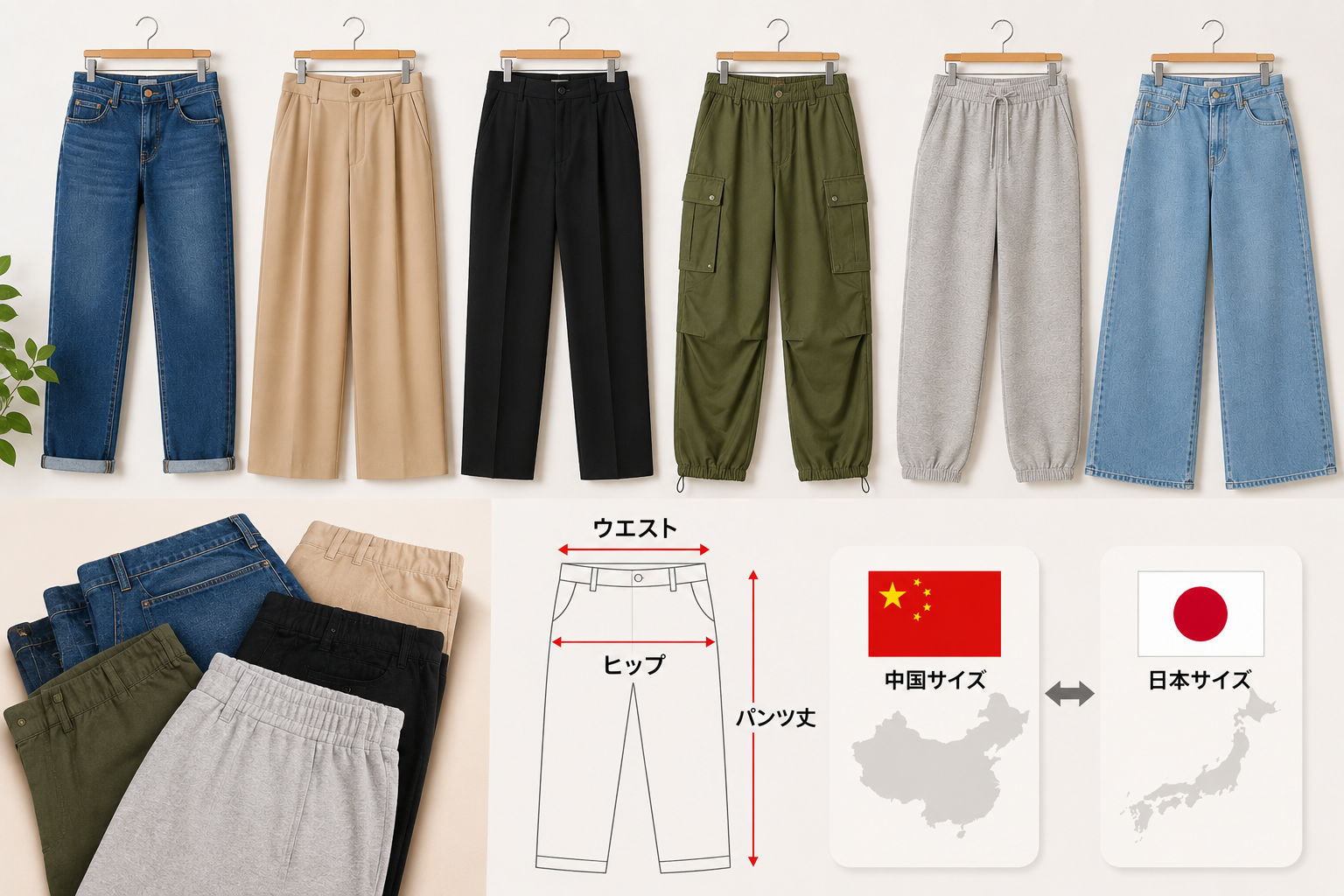
"Pants" is "裤子" in Chinese.
"Pants" in Chinese is
裤子 (kù zi / kuzu)
in Chinese.
The character “裤” corresponds to the Japanese terms “zubon” and “pants.”
On Chinese e-commerce sites, you can search using just “裤子,” but in practice, people often combine it with product characteristics to refine their search.
For example,
- Women’s pants: 女裤
- Men’s pants: 男裤
- Long pants: 长裤
- Shorts: 短裤
- Jeans: 牛仔裤
These are some examples of such terms.
When searching for products on Chinese sourcing sites, it’s easier to narrow down your results by entering the specific type of product you want in Chinese rather than just searching for “裤子.”
List of Chinese Terms for Different Types of Pants and Underwear
In China, just like in Japan, there are many different types of pants.
Here is a list of useful Chinese terms for searching for products on 1688, Taobao, and other sites.
| Japanese | Chinese | Pinyin |
| Pants | 裤子 | kù zi |
| Women's Pants | Women’s pants | nǚ kù |
| Men's Pants | Men's pants | nán kù |
| Long pants | Long pants | cháng kù |
| Shorts | Shorts | duǎn kù |
| Jeans / Denim pants | Jeans | niú zǎi kù |
| Wide-leg pants | Wide-leg pants | kuò tuǐ kù |
| Straight-leg pants | Straight-leg pants | zhí tǒng kù |
| Skinny pants | Tight-fitting pants | jǐn shēn kù |
| Cargo pants | Work pants | gōng zhuāng kù |
| Sweatpants | Sweatpants | wèi kù |
| Casual pants | Casual pants | xiū xián kù |
| Suit pants | 西装裤 | xī zhuāng kù |
| Flared pants | Bell-bottom pants | lǎ ba kù |
| High-waisted pants | High-waisted pants | gāo yāo kù |
| Low-rise pants | Low-rise pants | dī yāo kù |
| Cropped pants | 9/10-length pants | jiǔ fēn kù |
| Three-quarter-length pants | 7/10-length pants | qī fēn kù |
| Overalls | Overalls | bēi dài kù |
| Leggings | Leggings | dǎ dǐ kù |
| Yoga pants | Yoga pants | yú jiā kù |
| Leather pants | Leather pants | pí kù |
| Corduroy pants | Corduroy pants | dēng xīn róng kù |
On Chinese websites, you can search for these product names by adding keywords such as “women’s,” “men’s,” “summer,” “high-waisted,” or “loose-fitting.”
"Jeans" is "牛仔裤" in Chinese.
Jeans and denim pants, which are often purchased in Japan, are called
牛仔裤 (niú zǎi kù)
in Chinese.
"牛仔" is a term that refers to denim or cowboys, and it’s a very common keyword on Chinese e-commerce sites.
For example, if you’re looking for women’s wide-leg denim, search for
"women's wide-leg jeans"
.
Additionally,
"high-waisted" = high-waisted
, "loose-fitting" = loose
, "straight-leg" = straight
, "slimming" = makes you look slimmer
and other terms will make it easier to find the items you’re looking for.
Chinese Terms for Denim Pants
| Japanese | Chinese |
| Denim/Jeans | 牛仔 |
| Jeans | Cowboy Pants |
| Wide-leg denim | Wide-leg jeans |
| Straight-leg denim | Straight-leg jeans |
| Skinny jeans | Skinny Jeans |
| High-Waisted Denim | High-Waisted Jeans |
| Distressed Jeans | Ripped jeans |
| Loose-fitting jeans | Loose-fitting jeans |
"Wide-leg pants" are called "阔腿裤" in Chinese.
In Chinese, wide-leg pants are called
阔腿裤 (kuò tuǐ kù)
.
“阔” means “wide” and “腿” means “leg,” so it literally refers to pants with wide legs.
It’s a keyword frequently used in women’s fashion products in China.
For example,
high-waisted wide-leg pants
translates to “high-waisted wide-leg pants.”
"Women’s Summer Lightweight Wide-Leg Pants"
would mean “women’s, summer, lightweight, wide-leg pants.”
When searching for products, the key is to combine multiple characteristics like this, rather than using just a single word.
"Cargo pants" are called "工装裤" in Chinese.
A common Chinese term used when looking for cargo pants is
工装裤 (gōng zhuāng kù)
.
“工装” refers to workwear, and in the fashion industry, it is used to describe products like cargo pants and work pants.
For example,
"women's loose-fitting work pants"
will help you find loose-fitting cargo pants designed for women.
Useful Chinese Phrases for Finding Pants on Chinese Websites
Learning Chinese terms that describe not only the names of pants but also their silhouettes and materials will make searching for products even more convenient.
| Japanese | Chinese |
| Women's | Women |
| Men's | Men |
| High-waisted | High-waisted |
| Low-waist | Low-waist |
| Loose-fitting | Loose |
| Slim | Fitted |
| Slimming | Slimming |
| Straight | Straight-leg |
| Wide | Wide-leg |
| Lightweight | Lightweight |
| Heavyweight | Reinforced |
| Spring/Summer | Spring/Summer |
| Fall/Winter | Fall/Winter |
| Elastic waistband | Elastic waistband |
| Plus Size | Large sizes |
| Small size | Small |
For example, if you want to search for “women’s high-waisted wide-leg pants for spring and summer” on 1688,
Women Spring/Summer High-Waisted Wide-Leg Pants
you can search using this combination.
Rather than simply translating the Japanese product name, it’s easier to find products on Chinese websites if you break down your search keywords into categories such as “gender + season + features + product name.”
Are pants sizes different in China and Japan?
When sourcing pants from China, you should pay close attention to the size labels.
China has its own standards for clothing sizes, with the national standard for men’s clothing being “GB/T 1335.1-2008” and for women’s clothing being “GB/T 1335.2-2008.”
On the other hand, on Chinese e-commerce platforms,
S
, M
, L
, XL
, 2XL
, and 3XL
—size labels familiar in Japan—are used for many products.
It’s important to note that
“A Chinese size M is not necessarily the same as a Japanese size M.”
.
Even if they’re both labeled “M,” the waist, hip, rise, and total length can vary depending on the manufacturer and product.
Therefore, when sourcing pants from China, it’s important not to base your decision solely on the S, M, or L size labels.
Chinese phrases to check when looking at Chinese pants sizes
Chinese product pages sometimes include a “尺码表 (size chart).”
Let’s learn some common Chinese terms that often appear in these contexts.
| Chinese | Japanese |
| 尺码 | Size |
| Size Chart | Size Chart |
| Waist Circumference | Waist |
| Hip Circumference | Hip |
| Pants Length | Total Length / Inseam |
| Thigh Circumference | Thigh Circumference |
| Cuff | Hem |
| Cuff Circumference | Hem circumference |
| Front rise | Front rise |
| Back Rise | Back rise |
| Inseam | Inseam |
| Elastic waistband | Elastic waist |
Especially for pants,
Waist,
Hip,
and Total Length
are the three measurements you should check.
How do Chinese S, M, and L sizes compare to Japanese sizes?
When sourcing products from China, people often say, “Chinese sizes are smaller than Japanese ones.”
While this is certainly true for some products,
we do not recommend converting sizes across the
board, such as:
we do not recommend applying this conversion across the board.
This is because even among Chinese products, sizing varies depending on the brand, factory, and the item’s silhouette.
Especially with pants, the fit can vary significantly depending not only on the waist size but also on the hip size, rise, thigh, width, and total length.
Therefore, when selling products sourced from China in Japan, we recommend creating size information tailored to the Japanese market based on actual measurements, as follows:
Example
On a Chinese product page,
"Size
M: Waist: 68 cm
, Hip: 94 cm
, Inseam: 100 cm"
is listed,
instead of mechanically converting it to “Chinese M = Japanese S,”
M
: Waist: approx. 68 cm
, Hips: approx. 94
cm, Total Length: approx. 100 cm
.
Based on that, we then determine the size labeling for sale in Japan.
What do Chinese size notations like “160/68A” mean?
For Chinese clothing,
160/68A
.
Unlike simple S, M, and L sizes, these are size labels based on body measurements.
For pants, generally:
160 = “hao” (a unit representing height)
, 68 = “xing” (a unit representing body circumference, such as waist size)
, and A = “body type classification.”
.
Therefore, if you come across a size listed as “160/68A,” it’s important to check the actual measurements on the product page rather than simply substituting it for a Japanese S or M.
When sourcing pants from China, be sure to check the “size chart”
When sourcing underwear from China, you should pay special attention to the size chart.
Even if they’re both labeled “Size M,”
it’s not uncommon for Product A to have a waist of 68
cm and Product B to have a waist of 72 cm
—this is not uncommon.
Also, depending on the product page,
sizes may be listed as "flat measurements"
.
Therefore,
it’s important to check the actual product dimensions
but rather to check the actual product dimensions.
If possible, request a sample before purchasing,
- waist
- hip
- rise
- Inseam
- Total Length
- Thigh Width
- Hem Width
It’s a good idea to measure these and other dimensions yourself before creating a product page for the Japanese market.
A Specific Example of Searching for Pants on a Chinese Website
Finally, here are a few search keywords you can use on Chinese websites like 1688.
Women’s wide-leg pants
Women’s wide-leg pants
Women's high-waisted wide-leg pants
Women’s high-waisted wide-leg pants
Lightweight wide-leg pants for summer
Women's Lightweight Summer Wide-Leg Pants
Women's Straight-Leg Jeans
Women's Straight-Leg Jeans
High-Waisted Wide-Leg Denim
Women's High-Waisted Wide-Leg Jeans
Men's Casual Pants
Men's Casual Pants
Men's Cargo Pants
Men's Loose-Fit Work Pants
Women's Plus-Size Pants
Women's Plus-Size Pants
As you can see, just learning a few Chinese product names can greatly expand the range of products you can search for on Chinese shopping sites.
Can I source products from China even if I don't understand Chinese?
When you start sourcing from China,
"If I don't speak Chinese, won't I be unable to source from 1688?"
Some people might feel this way.
However, you don’t need to learn all of the Chinese language.
When searching for products,
pants
= pants, jeans
= jeans, wide-leg pants
= wide-leg pants, cargo pants
= cargo pants, waist
= waist, hip
= hip, pant length = total length
—just knowing these commonly used terms makes searching for products much easier.
At HubBuyer, we support Japanese businesses looking to find and source products from China.
Even if you don’t know the Chinese product names, it helps to first identify the features of the products you want to sell in Japan—this will make your search much easier.
Summary | "Pants" are called "裤子" in Chinese. Learning the Chinese terms for different types of pants makes it easier to find what you're looking for.
Pants are called “裤子 (kù zi)” in Chinese.
However, on Chinese sourcing websites, rather than searching for just “裤子,”
it’s easier to find the items you’re looking for by searching using the Chinese terms that describe the specific types of pants, such as: “牛仔裤” (jeans
), “阔腿裤” (wide-leg pants
), “直筒裤” (straight-leg pants
), “工装裤” (cargo
pants), “短裤” (shorts
), and “休闲裤” (casual pants)
—that is, using the Chinese terms for the product categories—rather than just “裤子” will make it easier to find the items you’re looking for.
Also, when sourcing pants from China, you need to be aware of the differences in sizing notation between Japan and China.
Don’t simply convert “S, M, L” to Japanese sizes; instead,
but be sure to check the actual measurements, such as waist circumference (waist)
, hip circumference (hips)
, and total length (length)
and other actual measurements.
If you learn how to read Chinese product names and size charts, it will make product research on platforms like 1688 and Taobao much easier.
When sourcing apparel products from China, it’s important to verify not only the translation of the product name but also product information such as size, specifications, and materials before placing an order.